Over 40% of Americans who invest in foreign mutual funds unknowingly trigger PFIC rules and face tax penalties up to 37% plus interest. That shocking statistic comes from tax professionals who regularly see clients get hit with unexpected bills from the IRS. Many investors think they are being smart by diversifying globally, only to discover they created a tax nightmare. Passive foreign investment sounds like a good idea until you understand how the IRS treats it. This article will explain what passive foreign investment really means, why it can cost you thousands in extra taxes, and how to invest internationally without triggering these punishing rules. You will learn practical steps to protect yourself and smart alternatives that give you global exposure without the tax headaches.
What Is Passive Foreign Investment
Passive foreign investment refers to money you put into certain foreign companies that the IRS classifies as PFICs, or Passive Foreign Investment Companies. The term sounds complicated, but it simply means foreign corporations that earn most of their income from passive sources like interest, dividends, or capital gains. If you own shares in these companies, you face special tax rules that are much harsher than normal investment taxation.
A foreign company becomes a PFIC if it meets one of two tests. The income test says that 75% or more of the company’s gross income comes from passive sources. The asset test says that 50% or more of the company’s assets produce passive income or are held to produce passive income. Most foreign mutual funds automatically meet these tests because they hold portfolios of stocks and bonds.
Common examples include foreign mutual funds, international ETFs not domiciled in the United States, Canadian investment trusts, and offshore hedge funds. Even your foreign pension plan might count as a PFIC. Many Americans living abroad or with international ties own these investments without realizing the tax consequences.
Why People Invest in Foreign Companies
Investors put money into foreign companies for good reasons. Diversification across different countries reduces risk because economies do not all move together. When US markets struggle, Asian or European markets might thrive. This balance helps protect your portfolio from major losses.
Foreign markets also offer access to growing companies and industries not available in America. Emerging markets in Asia, Latin America, and Africa have younger populations and faster economic growth. Some of the best performing stocks over the past decade came from these regions. Many investors want exposure to this growth potential.
Currency advantages provide another benefit. If the dollar weakens against other currencies, your foreign investments gain value. Some people view international investing as a hedge against dollar decline. Popular foreign investments include European luxury goods companies, Asian technology firms, and international real estate funds.
The PFIC Problem Explained
Congress created PFIC rules in 1986 to stop wealthy Americans from deferring taxes by parking money in foreign investment companies. The idea was to eliminate the tax advantage these offshore funds provided. Lawmakers made the rules intentionally punishing to discourage this behavior. The problem is that regular investors now get caught in the same harsh system.
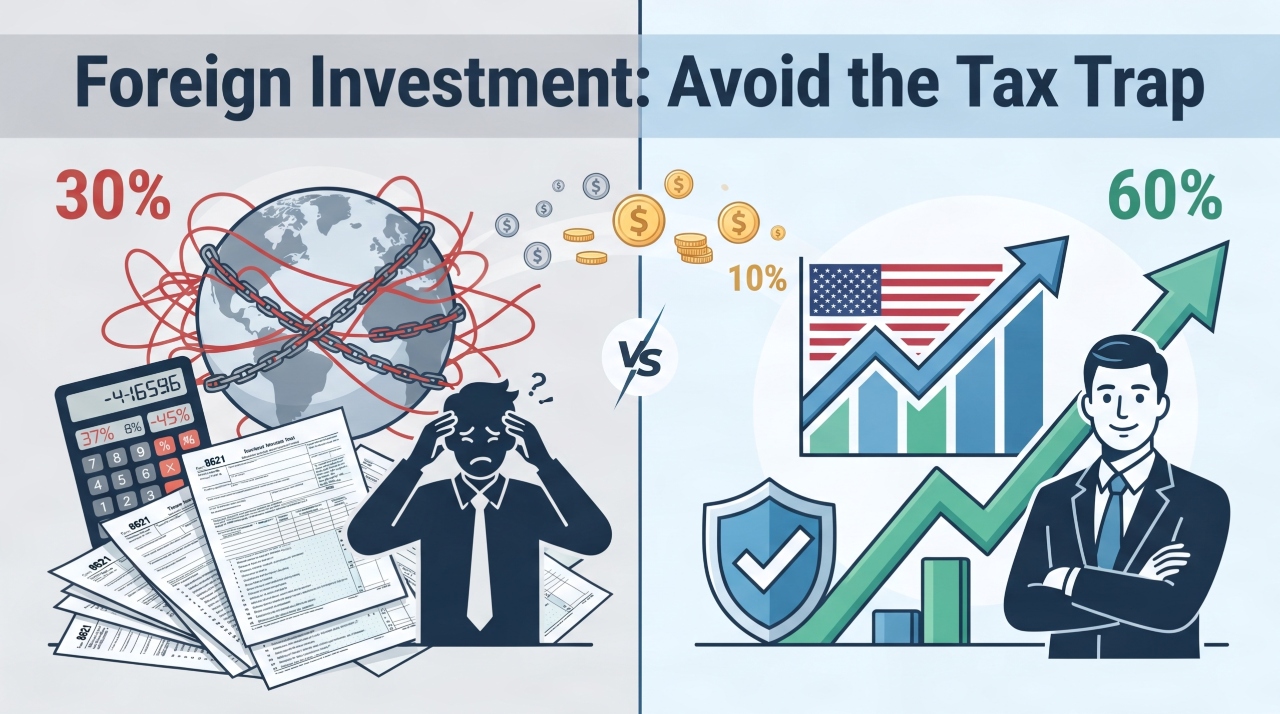
PFIC taxation differs completely from how the IRS treats domestic investments. With normal stocks or mutual funds, you pay capital gains tax only when you sell, usually at favorable rates of 15% or 20%. With PFICs under the default rules, you face ordinary income tax rates up to 37%, plus interest charges that compound over your holding period.
The IRS provides detailed guidance on PFIC taxation methods and reporting requirements on their official Form 8621 page. The default method treats all gains as ordinary income spread over your holding period with interest charges. The QEF or Qualified Electing Fund method taxes you annually on your share of the fund’s earnings, whether distributed or not. The MTM or mark to market method taxes annual gains and allows deduction of annual losses. Each method has strict requirements and drawbacks.
Most investors never learn about these rules until tax time. They buy what seems like a normal international fund through their broker, hold it for years, then discover they owe taxes plus interest dating back to their purchase. The calculations are complex and the penalties severe. A $10,000 gain that would cost $1,500 in normal capital gains tax might cost $5,000 or more under PFIC rules.
Common Passive Foreign Investments That Trigger PFIC Rules
Foreign mutual funds top the list of investments that trigger PFIC status. If you buy a mutual fund organized in Europe, Asia, or anywhere outside the United States, it almost certainly qualifies as a PFIC. This includes funds that seem identical to American funds but happen to be registered abroad.
International ETFs can be tricky. ETFs traded on US exchanges and organized in the United States do not count as PFICs, even if they invest in foreign stocks. But ETFs organized in foreign countries do trigger the rules. You must check where the fund itself is domiciled, not just what it invests in.
Foreign pension plans often qualify as PFICs. Americans working abroad who contribute to local retirement plans may face PFIC reporting requirements. Canadian RRSPs and TFSAs can trigger these rules for US residents or citizens. Foreign life insurance policies with investment components usually count as PFICs because the cash value grows through passive investments.
Offshore hedge funds organized in places like the Cayman Islands or Luxembourg typically qualify. Foreign REITs that invest in real estate can go either way depending on how actively they manage properties. Even some foreign operating companies might meet the PFIC tests if they hold substantial cash or investment portfolios.
| Investment Type | Usually a PFIC? | Why |
|---|---|---|
| Foreign mutual funds | Yes | Meet income and asset tests |
| US-domiciled international ETFs | No | US tax structure |
| Foreign ETFs | Yes | Foreign registration |
| Canadian RRSPs | Often yes | Investment holdings |
| Foreign operating companies | Sometimes | Depends on cash holdings |
The Tax Consequences You Face
The default PFIC taxation method can devastate your returns. When you sell PFIC shares at a gain, the IRS treats the profit as ordinary income taxed at rates up to 37%. The agency then assumes you earned that gain evenly over your entire holding period and charges interest on the theoretical deferred tax for each year.
An excess distribution calculation makes things worse. The IRS compares your current year gains or distributions to the average from prior years. Anything above 125% of that average gets special treatment with the interest charge added. This complex calculation requires detailed records going back to your purchase date.
Real numbers show the damage. Imagine you bought a foreign fund for $10,000 and sold it five years later for $20,000. Under normal capital gains rules, you would pay about $1,500 in federal tax on your $10,000 profit. Under default PFIC rules, you might pay $3,700 in tax plus $800 in interest charges, totaling $4,500. Your effective tax rate jumps from 15% to 45%.
These rules apply regardless of your tax bracket for other income. Even if you normally pay low rates, PFIC gains get hit with the highest ordinary income rates. The interest charge typically runs around 5% to 7% annually, compounding over your holding period. Long term holdings face the biggest penalties.
Holding PFICs in retirement accounts provides no protection. The IRS still requires reporting and taxation on gains. State taxes add another layer of pain because most states follow federal treatment. California, New York, and other high tax states can push your total PFIC tax rate above 50% when you combine federal and state levies.
Form 8621: The Reporting Nightmare
Form 8621 strikes fear into tax professionals. This complex form must be filed for each PFIC you own, every single year you hold it. If you own five different foreign funds, you file five separate forms. Missing even one form triggers penalties that can exceed the value of your investment.
The form requires detailed information most investors do not have. You need the fund’s earnings and profits, your pro rata share of those amounts, and calculations of excess distributions. Foreign fund companies rarely provide this data to American investors. Without it, you cannot complete the form properly or make beneficial tax elections.
Filing requirements kick in when you own PFIC shares at any point during the tax year. Selling the shares does not eliminate your obligation to report for that year. You must file even if the investment lost money or you received no distributions. Many people discover years later that they should have been filing and now face penalties.
Penalties for not filing Form 8621 start at $10,000 per form per year. If you owned three PFICs for three years without filing, you potentially owe $90,000 in penalties before any tax. The IRS can also keep the statute of limitations open indefinitely when forms are missing, meaning they can audit you forever.
Most tax preparation software cannot handle Form 8621. The calculations are too complex and specialized. Hiring a tax professional with PFIC experience typically costs $500 to $1,500 per form. If you own multiple PFICs over several years, professional fees alone can run into thousands of dollars.
The QEF Election: Your Best Tax Option
A Qualified Electing Fund election offers the best tax treatment for PFICs if you can make it. This election changes how the IRS taxes your foreign investment, making it work more like a partnership. You pay tax annually on your share of the fund’s earnings, whether the fund distributes cash to you or not.
QEF treatment means you pay tax at normal capital gains rates instead of ordinary income rates. You avoid the excess distribution calculation and the punishing interest charges. Your gains get taxed as they occur, eliminating the deferral penalty. Long term gains qualify for the favorable 15% or 20% capital gains rates most investors enjoy.
Making a QEF election requires the foreign fund to provide an annual PFIC Annual Information Statement. This document shows the fund’s ordinary earnings and capital gains for the year, along with your proportionate share. The problem is that most foreign funds refuse to prepare these statements. They have no obligation to help American investors comply with US tax law.
You must make the QEF election by the due date of your tax return for the first year you own the PFIC shares. Missing this deadline means you cannot use QEF treatment unless you qualify for late election relief, which requires professional help and reasonable cause. Some investors make a deemed sale election to purge prior years, paying tax on built up gains to start fresh with QEF status.
The benefits are substantial when available. A QEF taxed investment performs almost like a US mutual fund for tax purposes. The drawback is you pay tax annually even if you receive no cash distributions, which can strain your budget. You need cash from other sources to pay the tax bill.
The Mark to Market Election
The mark to market election provides a middle ground between default treatment and QEF status. This election requires you to treat the PFIC as if you sold it on the last day of each tax year at fair market value. You report the hypothetical gain or loss on your return annually.
MTM treatment taxes gains as ordinary income, not capital gains. This is worse than QEF treatment but better than default PFIC rules because you avoid the interest charge and excess distribution calculations. You pay tax each year as gains accrue, similar to QEF treatment. The annual taxation eliminates the compounding penalty.
Only marketable stock qualifies for MTM election. The PFIC shares must trade on a qualified exchange where you can easily determine the year end value. Foreign mutual funds that publish daily net asset values typically qualify. This makes MTM available when QEF is not, since most foreign funds will not provide QEF statements but do publish their values.
Losses under MTM can be deducted as ordinary losses, but only up to the amount of prior MTM gains. This limitation prevents you from creating large deductions if your investment declines sharply. The election applies going forward and can be revoked only with IRS permission.
MTM makes sense when you own marketable PFIC shares and cannot make a QEF election. The ordinary income tax rate hurts, but avoiding the interest charge saves money on long term holdings. You must make the election on a timely filed return for the first year it applies.
How to Avoid PFIC Status Legally
The easiest way to avoid PFIC problems is to invest in US based international funds. American mutual fund companies offer hundreds of funds that invest in foreign stocks and bonds. These funds are organized in the United States, so they never trigger PFIC rules. You get the same foreign market exposure without the tax complications.
Vanguard, Fidelity, and Schwab all offer international stock funds, emerging market funds, and foreign bond funds that are perfectly safe from PFIC treatment. These funds hold the same foreign securities that foreign funds hold. The only difference is the legal structure and domicile. Your tax treatment stays simple and favorable.
American Depositary Receipts provide another solution. ADRs represent shares of foreign companies but trade on US exchanges like regular stocks. They do not trigger PFIC rules in most cases because they represent direct ownership in operating companies, not investment funds. You can buy shares of major foreign corporations without PFIC concerns.
US domiciled ETFs work the same way. An ETF organized in America that invests in international stocks is not a PFIC. Check the fund prospectus or ask your broker where the fund is legally domiciled. The trading exchange matters less than where the fund itself is registered.
Before buying any foreign investment, verify its status. Call the fund company and specifically ask if it is a PFIC for US tax purposes. Check the prospectus for the country of organization. Search online databases that track PFIC status. Your broker should be able to confirm this information but sometimes gets it wrong, so verify yourself.
Safe alternatives for global exposure include US international mutual funds, US based international ETFs, ADRs of foreign companies, and direct ownership of foreign operating company stocks that are not PFICs. You can build a completely diversified global portfolio without touching a single PFIC.
What to Do If You Already Own PFICs
First, assess exactly what you own. Gather statements and prospectuses for all your foreign investments. Determine which ones qualify as PFICs. Not every foreign investment triggers these rules, so identify the problem holdings specifically. Make a list with purchase dates and cost basis for each PFIC.
Next, decide whether to sell or hold. Selling eliminates future reporting obligations but triggers tax on your gains under the punishing default rules if you never made protective elections. Sometimes selling makes sense despite the tax hit, especially if gains are small or you have losses to offset them. Other times holding and making elections going forward costs less.
Consider making protective elections even if you plan to sell eventually. A QEF election or MTM election made now can reduce taxes on future gains. You might file delinquent Forms 8621 for prior years to come into compliance. The IRS offers relief programs for taxpayers who failed to report PFICs due to reasonable cause.
Streamlined filing procedures help Americans abroad or those with simple PFIC situations catch up on reporting. You file the past three or six years of delinquent forms with a statement explaining why you missed them. Penalties may be reduced or eliminated if you qualify. This process requires professional help in most cases.
Calculate the cost of various options. Compare the tax on selling now versus holding with elections versus doing nothing and hoping you do not get caught. Factor in professional fees to prepare forms and elections. Sometimes the math clearly favors one approach. Other times the choice is less obvious.
Get professional help for anything beyond the simplest situation. Tax attorneys or CPAs with PFIC experience can evaluate your specific circumstances. They know which elections work best and how to minimize damage. The cost of professional advice pays for itself by avoiding mistakes that could cost thousands.
Special Situations and Exceptions
The IRS provides a de minimis exception that helps small investors. If the total value of all PFIC stock you own is $25,000 or less, and you are unmarried, you may not need to file Form 8621 in some cases. Married couples filing jointly get a $50,000 threshold. This exception has limitations and does not eliminate tax liability, just some reporting requirements.
Stock held through US pension plans like 401k accounts receives different treatment. The retirement account itself is not subject to current PFIC taxation while funds remain in the account. Distributions from the account face normal retirement account rules. This exception only applies to US qualified retirement plans, not foreign pensions.
Directly owned foreign operating companies sometimes escape PFIC status. If you own stock in a foreign corporation that actively operates a business rather than just holding passive investments, it might not meet the PFIC tests. Manufacturing companies, retailers, and service businesses that derive most income from operations are often safe. You must verify this annually because a company’s status can change.
Canadian registered accounts create special problems for US citizens. RRSPs may qualify for treaty benefits that reduce or eliminate PFIC taxation if you make proper elections. TFSAs offer no such relief and typically trigger full PFIC treatment. Americans in Canada need specialized advice on these accounts.
Some tax treaties provide benefits that modify PFIC treatment. The details vary by country and situation. Treaty benefits must be claimed properly and do not always override PFIC rules completely. Research the specific treaty between the United States and the country where your investment is located.
Working with Tax Professionals on PFIC Issues
PFIC taxation is so specialized that most general tax preparers cannot handle it. Even experienced CPAs often lack expertise in this area. You need someone who regularly deals with international tax and specifically understands PFIC rules. Ask potential advisors how many PFIC returns they prepare each year.
Good questions to ask include whether they have handled QEF elections before, if they are familiar with streamlined filing procedures, and what their fee structure looks like. Get a clear estimate upfront because PFIC work is expensive. Typical costs range from $500 to $2,000 per PFIC per year depending on complexity.
Enrolled agents and CPAs with international tax credentials are good options. Some tax attorneys specialize in this area. Large accounting firms have international tax departments that handle PFIC issues. Smaller practitioners who focus on expat taxation often have deep PFIC knowledge.
Red flags include anyone who says PFIC issues are no big deal or suggests ignoring the reporting requirements. Run from advisors who guarantee the IRS will never find out or claim penalties never get enforced. The IRS has increased PFIC enforcement and shares information with foreign governments.
DIY is possible only in the simplest situations. If you own one PFIC with a small gain, bought recently, and plan to sell immediately, you might handle it yourself with good tax software and research. Anything more complex needs professional help. The cost of mistakes far exceeds professional fees.
Smart Strategies for Global Diversification Without PFIC Headaches
Building international exposure without PFIC problems is completely possible. Start with US mutual funds from major companies that invest globally. You can research and compare US-domiciled international funds using screening tools from Morningstar to find options that match your investment goals. A total international stock index fund gives you exposure to thousands of foreign companies in one simple investment. These funds are widely available and cost effective.
Combine broad international funds with regional funds for targeted exposure. An emerging markets fund adds growth potential from developing countries. A European stock fund provides developed market stability. All organized in the United States mean zero PFIC concerns.
Add some ADRs of specific foreign companies you believe in. If you want to own a major European automaker or Asian technology company, buy the ADR version that trades in New York. You get direct stock ownership with normal tax treatment.
Consider sector based approaches to foreign exposure. A global healthcare fund or worldwide technology fund invests across countries while focusing on industries. This provides international diversification plus sector concentration. US domiciled global sector funds avoid PFIC status.
A sample portfolio might include 40% US stocks, 30% international stocks through US funds, 20% bonds, and 10% ADRs of specific foreign companies. This structure gives you global diversification, growth potential, and income without a single PFIC. You can adjust percentages based on your risk tolerance and goals.
Recent Rule Changes and What They Mean
The IRS has tightened PFIC reporting requirements in recent years. Form 8621 became mandatory in more situations, and the agency increased penalty enforcement. Information sharing agreements with foreign countries now help the IRS identify Americans with foreign investments.
Reporting thresholds changed to catch more taxpayers. The IRS clarified that certain exceptions are narrower than previously thought. Guidance on QEF elections and deemed sale elections updated procedures. These changes generally make compliance harder and more expensive.
Enforcement trends show the IRS is serious about PFIC rules. Audit rates for returns with foreign investments have increased. The agency uses sophisticated data matching to find unreported foreign accounts and investments. Penalties actually get assessed, not just threatened.
Future changes might include reform to make the rules less punishing for innocent investors. Some tax professionals advocate for raising de minimis thresholds or creating safe harbors. Congress has shown little interest in reform so far. More likely we will see continued tightening of enforcement.
Stay informed by following IRS announcements and tax publications. Major accounting firms publish alerts when rules change. Online forums for expats and international investors share updates. Your tax professional should monitor developments and inform you of changes affecting your situation.
The Cost of Getting It Wrong
Real penalty examples show the stakes. One taxpayer failed to report three PFICs for five years and faced $150,000 in penalties before any tax or interest. Another investor owed $30,000 in penalties on a foreign fund worth $25,000. These are not worst case scenarios but typical situations for people who ignored the rules.
Audit risk increases substantially when you have foreign investments. The IRS targets international issues because they find high rates of noncompliance. Having foreign accounts or investments puts you in a higher risk category for examination. Audits are expensive and stressful even when you did nothing wrong.
Interest accumulation over time compounds your tax bill dramatically. The interest charge on deferred PFIC tax typically runs 5% to 7% annually. On a 10 year holding period, that interest can equal or exceed the tax itself. A $10,000 tax bill becomes $20,000 with accumulated interest.
Professional fees to fix PFIC problems after the fact run much higher than the cost of proper planning upfront. Preparing delinquent forms, making late elections, and negotiating penalty relief with the IRS can cost $10,000 or more. Compare that to a few hundred dollars for proper advice before investing.
Opportunity cost matters too. Money you pay in excess PFIC taxes and penalties is money not growing in your investment accounts. Over decades, this can mean hundreds of thousands in lost wealth. The inefficient taxation destroys the benefit of foreign returns.
Ignorance provides no defense with the IRS. Saying you did not know about PFIC rules will not eliminate your tax or penalties. The tax code puts the burden on you to understand and comply. Not knowing the law does not excuse violations.
Conclusion
Passive foreign investment creates serious tax problems for American investors who do not understand PFIC rules. The IRS designed these regulations to be punishing, and they succeed in devastating returns through high tax rates, interest charges, and complex reporting requirements. What seems like smart international diversification can turn into a financial disaster.
The good news is you have many alternatives. US based international funds provide the same global exposure without any PFIC complications. ADRs let you own specific foreign companies you like. American ETFs that invest worldwide are widely available and cost effective. You can build a completely diversified portfolio spanning every country and region without triggering these harsh rules.
If you already own PFICs, take action now before the problems multiply. Assess what you have, understand your options, and make informed decisions about selling or making protective elections. The cost of fixing PFIC issues only increases with time as penalties and interest accumulate.
Check every investment before you buy. Ask specifically about PFIC status. Read the prospectus to confirm where funds are organized. When in doubt, stick with US domiciled options that provide the same exposure without the tax headaches. A few minutes of research before investing can save thousands in taxes and penalties later.
Take Control of Your International Investments Today
Review your portfolio right now to identify any foreign investments that might be PFICs. Look at mutual funds, ETFs, foreign stocks, and any investment accounts held abroad. Make a list of anything that concerns you.
Contact a qualified tax professional with PFIC experience if you find problem investments. Do not wait until tax time when your options are limited. Get advice now while you still have time to make beneficial elections or plan your exit strategy. The consultation fee is small compared to potential penalties.
Use the resources mentioned in this article to research specific investments. Check fund prospectuses for country of organization. Call investment companies to verify PFIC status. Educate yourself so you can ask informed questions and make good decisions.
Consider moving money from foreign funds into US based international alternatives. The transition might trigger some tax, but it eliminates future PFIC problems. Your long term returns will benefit from efficient taxation and lower compliance costs.
File any missing Forms 8621 before the IRS discovers the problem. Voluntary disclosure with reasonable cause receives better treatment than waiting for an audit. Take control of the situation instead of hoping you never get caught.
Make international investing work for you without the PFIC nightmare. Smart planning and proper structure give you global diversification with simple, favorable tax treatment. Start today to protect your wealth and maximize your returns.