
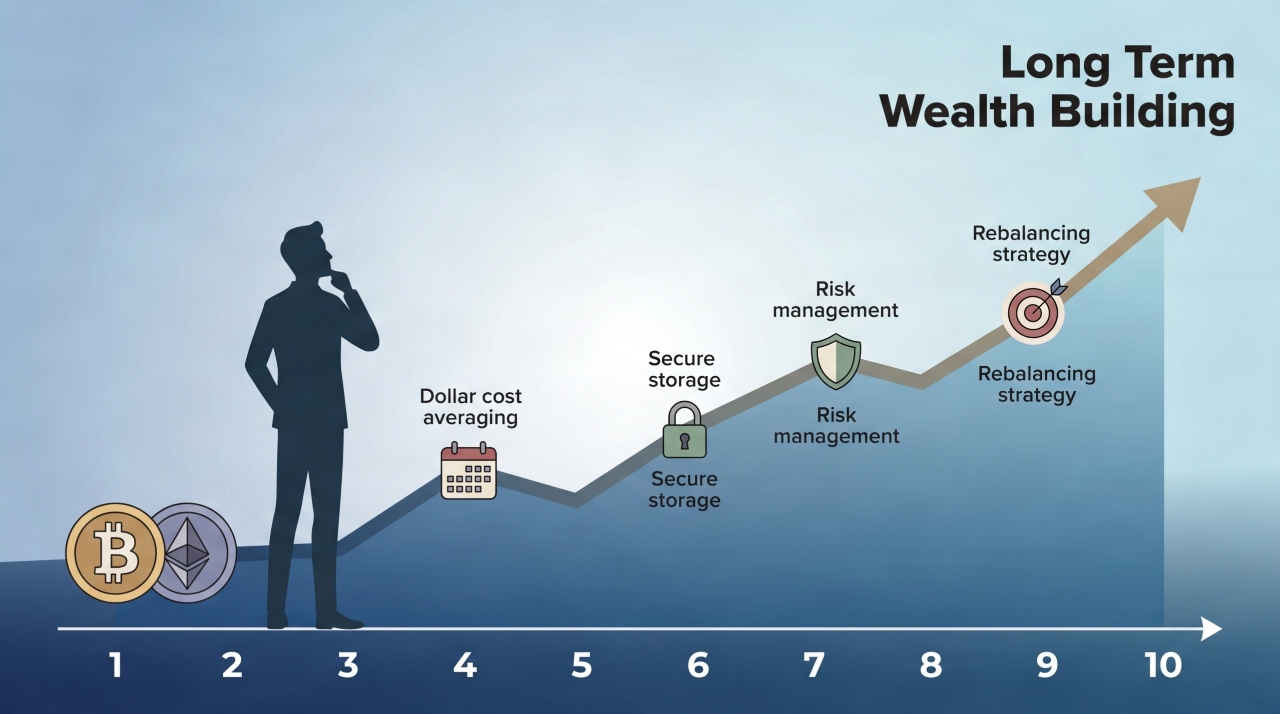
Bitcoin has outperformed the stock market over the past 10 years despite multiple 80% price crashes. This shows that long term crypto investment can build wealth if you pick the right assets and hold through volatility. The difference between making money and losing money often comes down to whether you can stay patient when prices drop.
Most people think about cryptocurrency as a quick way to make profits. They watch the price every day and sell whenever they get scared or greedy. This approach almost always fails. The best long term crypto investment strategy involves buying quality cryptocurrencies and forgetting about them for years. This article shows you exactly which cryptocurrencies deserve your long term attention and why.
You’ll learn about the top cryptocurrencies for holding long term. We’ll explain what makes each one worth holding instead of trading. You’ll discover how to build a portfolio that reduces risk while building wealth. Most importantly, you’ll understand the mental discipline required to succeed with long term crypto investing. Ready to build wealth the right way? Keep reading.
Why Long Term Crypto Investment Works Better Than Trading
Trading cryptocurrencies requires constant attention, market knowledge, and emotional control. Most people who try trading lose money consistently. Studies show that approximately 90% of day traders lose money. They battle fees, taxes, and psychological mistakes that professional traders struggle with too.
Long term investing takes the opposite approach. You buy quality cryptocurrencies and hold them for years. You check your portfolio once a month or once a quarter instead of hourly. You make fewer trades which means fewer opportunities to make mistakes. Your brain stays calm because you’re not constantly making emotional decisions.
The tax advantages of long term holding are substantial. In the United States, long term capital gains receive preferential tax treatment. If you hold an asset for more than one year, the tax rate drops dramatically compared to short term trading. Selling something after holding it for one year could save you 20% or more in taxes compared to selling it after holding it for weeks.
Compound growth works in your favor over long periods. If your investment grows 20% annually for 10 years, the total return exceeds what you’d expect from simple math. Your gains start earning gains themselves. Albert Einstein supposedly called compound interest the eighth wonder of the world because the math is so powerful.
Missing the best trading days costs serious money. If you stayed in the market for the last 20 years but missed just the 10 best days, your returns would be cut roughly in half. Nobody can predict which days will be the best ones. Most professional investors can’t identify those days. Trading out of the market to avoid crashes usually means missing the recoveries that happen unpredictably.
Time in the market really does beat timing the market. History repeatedly proves this. The longest bull market in history happened while most people were scared. Market bottoms happen when sentiment is worst and fear is highest. Trying to time these turns usually results in selling low and buying high, which destroys wealth.
Bitcoin: The Original and Still the Best Long Term Bet
Bitcoin is the original cryptocurrency and remains the dominant choice for best long term crypto investment. Created in 2009 by an unknown person or group named Satoshi Nakamoto Bitcoin official information, Bitcoin introduced the world to decentralized digital currency. Fourteen years of history give us confidence that Bitcoin’s model works and survives challenges.
The supply of Bitcoin is fixed at 21 million coins. This scarcity is built into the code permanently. Unlike government currency that can be printed endlessly, Bitcoin has a hard cap. Only 21 million Bitcoin will ever exist. Currently about 21.4 million Bitcoin have been mined, meaning nearly all Bitcoin that will ever exist has already been created. This scarcity creates value similar to gold or other rare resources.
Bitcoin’s primary purpose is storing value without relying on banks or governments. You can hold Bitcoin completely under your own control. Nobody can freeze your account or prevent you from accessing your money. This appeal matters increasingly as governments control financial systems more. Bitcoin represents financial freedom and independence.
Bitcoin’s price history shows steady upward progress despite massive crashes. From less than one cent to over $69,000 has been the journey. Bitcoin crashed 80% or more multiple times. Each time, it eventually recovered and reached new highs. This pattern suggests long term holders are rewarded even after devastating losses.
Institutional adoption of Bitcoin has accelerated dramatically. Major companies like MicroStrategy, Tesla, and Square have invested billions in Bitcoin. Large investors recognize Bitcoin as a legitimate asset class. This institutional validation supports continued adoption and price appreciation. When major institutions invest in something, credibility increases significantly.
Halvings occur roughly every four years when Bitcoin’s creation rate cuts in half. The next halving occurs in 2024. Historically, halvings have preceded major price increases within 12 to 18 months. The mechanism creates scarcity that pushes prices higher. This pattern suggests Bitcoin’s supply dynamics support price growth.
Risks exist with Bitcoin despite its advantages. Regulatory restrictions could reduce demand or functionality. A technical breakthrough might make Bitcoin obsolete somehow. The price could stay flat for years without delivering returns. No investment is guaranteed to succeed. However, Bitcoin’s track record and dominance make it the safest long term cryptocurrency investment.
Most financial advisors suggest Bitcoin should represent 50% to 60% of a crypto portfolio. This significant allocation reflects Bitcoin’s stability and proven track record. The largest position in a crypto portfolio should be your safest bet. Bitcoin fills that role for long term investors.
Ethereum: Smart Contracts and Growing Adoption
Ethereum launched in 2015 and created something new in cryptocurrency. Rather than focusing purely on payments like Bitcoin, Ethereum runs programs called smart contracts Ethereum official documentation. These programs execute automatically when conditions are met. Developers can build entire applications on Ethereum.
Thousands of projects have been built on Ethereum. These include lending platforms, trading exchanges, games, and many other applications. The diversity of projects shows Ethereum’s versatility. Many successful crypto companies rely on Ethereum for their operations. This ecosystem creates real value that justifies Ethereum as the best long term crypto investment.
Developer activity on Ethereum is massive. Thousands of developers worldwide contribute code to Ethereum projects. The number of developers continues growing. More developers means more innovation and more applications. The platform with the most talented developers tends to win in the long run.
Ethereum completed a major upgrade in 2022 called “The Merge.” This upgrade switched Ethereum from Proof of Work to Proof of Stake. The change reduced energy consumption and improved scalability. Technical improvements make Ethereum more attractive to users and developers. Continued upgrades suggest the platform will keep improving.
Staking rewards are available for Ethereum. You can lock your Ethereum in the network and earn new Ethereum created as rewards. Current staking returns exceed 3% annually. This passive income beats savings accounts and bonds. Holding Ethereum actually generates more Ethereum through staking. This income component adds to long term returns.
Transaction volumes on Ethereum are enormous. The platform processes more economic activity than any other blockchain. Millions of transactions occur daily. This usage validates Ethereum’s importance in the crypto ecosystem. Platforms with real usage have better long term prospects than platforms with no users.
DeFi applications running on Ethereum manage billions of dollars. Lending platforms, trading protocols, and other financial services operate on Ethereum. This financial activity creates value and generates fees paid to Ethereum. More DeFi adoption means more value flowing through the Ethereum network.
Competition threatens Ethereum’s dominance. Solana, Polkadot, and Avalanche offer various advantages. However, Ethereum’s first mover advantage and network effects remain powerful. Most developers choose Ethereum because the most active development community is there. This creates a self reinforcing cycle where Ethereum gets better faster.
Most financial advisors suggest Ethereum represent 20% to 30% of a crypto portfolio. This significant but smaller allocation reflects Ethereum’s risks compared to Bitcoin. However, Ethereum’s dominance in smart contracts makes it an essential holding. Any long term crypto portfolio should include meaningful Ethereum exposure.
Stablecoins: Lower Risk but Real Returns
Stablecoins are cryptocurrencies designed to maintain a stable price. USDC and USDT are the two largest stablecoins. They aim to maintain a value of exactly one dollar. Unlike Bitcoin and Ethereum which fluctuate wildly, stablecoins barely move in price.
Stablecoins maintain their value through backing. USDC is backed by actual dollars held in bank accounts. For every USDC token in existence, one real dollar sits in reserve. This backing ensures the price stays near one dollar. You can trust stablecoins to hold their value.
Interest earning opportunities exist with stablecoins. You can deposit stablecoins on lending platforms and earn interest. Current rates range from 4% to 8% annually depending on the platform. These returns beat traditional savings accounts which offer less than 1%. You get safety plus better returns than banks provide.
The appeal of stablecoins for long term investing is reducing volatility stress. You can hold stablecoins instead of cash and earn meaningful interest. You avoid watching your portfolio swing 30% in a week. This peace of mind has value. Some investors allocate 10% to 15% of their crypto portfolio to stablecoins for this reason.
Regulatory risks exist with stablecoins. Governments might restrict how stablecoins work. The SEC has proposed regulations that could change stablecoins dramatically. Future regulations could prevent earning interest or limit stablecoin usage. However, stablecoins have become so embedded in cryptocurrency that eliminating them seems unlikely.
Stablecoins are not truly long term growth investments. They maintain value but don’t appreciate like Bitcoin or Ethereum. You hold stablecoins for stability and emergency reserves. You hold Bitcoin and Ethereum for growth. A balanced portfolio includes both for different purposes.
Solana: Fast Growing Alternative
Solana is a blockchain focused on speed and low costs. The network can process thousands of transactions per second. Ethereum can process roughly 15 transactions per second. Solana is roughly 400 times faster. This speed advantage appeals to developers who want quick transaction finality.
Transaction costs on Solana are tiny compared to Ethereum. A transaction on Ethereum might cost $5 to $50. The same transaction on Solana costs pennies. These lower costs make applications viable that would be too expensive on Ethereum. Cost advantages attract developers and users.
Developer adoption of Solana has grown steadily. Major companies like FTX, Magic Eden, and Phantom have built on Solana. The ecosystem continues expanding. More developers choosing Solana suggests growing acceptance. Developer adoption matters more than any other factor for long term success.
Network outages have occurred on Solana in the past. The network stopped processing transactions for hours. This reliability issue has been largely resolved through improvements. However, it damaged Solana’s reputation. Ethereum has never experienced network outages. Bitcoin has never experienced network outages. Solana’s history of outages remains a concern.
Solana’s ecosystem is smaller than Ethereum’s. Fewer applications are built on Solana. Transaction volumes are lower. The platform hasn’t achieved as many use cases yet. However, growth potential is substantial if Solana can capture developer attention.
Most investors allocate 5% to 10% to Solana if they include it. The higher risk compared to Bitcoin and Ethereum justifies smaller positions. Solana could become a major platform or could fade into obscurity. The uncertainty suggests not making it a primary holding.
Evaluating Crypto for Long Term Holding
Not all cryptocurrencies deserve your money. Some projects are scams. Others have good ideas but poor execution. Knowing how to evaluate cryptocurrencies prevents losses. Start by looking at market cap.
Market cap is calculated by multiplying the token price by the number of tokens in circulation. Bitcoin’s market cap exceeds one trillion dollars. Ethereum’s market cap exceeds $200 billion. Smaller coins have market caps in the millions. Generally larger market caps indicate more established projects. The top 10 cryptocurrencies by market cap are safer bets than random coins.
Developer activity shows commitment to development. Check GitHub repositories for code commits. Look for active development happening regularly. Projects with no code updates in months are likely abandoned. Developer activity predicts which projects will survive.
Adoption statistics reveal real usage. Check how many transactions occur daily. Look at how many users hold the token. Review how many applications are built on the platform. Real adoption is more valuable than hype. Projects with real usage have better long term prospects.
Team credibility matters enormously. Research the background of key team members. Do they have experience in technology and business? Do they have successful projects in their history? Unknown teams carry higher risk. Experienced teams with proven track records are more trustworthy.
Regulatory clarity indicates if the project can operate safely. Some countries ban certain cryptocurrencies. Others provide clear rules about how projects must operate. Projects with regulatory clarity face fewer future surprises. Projects with unclear legal status carry regulatory risk.
Use case evaluation determines if the cryptocurrency solves real problems. Bitcoin solves the problem of money without banks. Ethereum solves the problem of applications without centralized control. Projects should solve specific problems that enough people care about. Projects solving no real problems are eventually worthless.
Building a Long Term Crypto Portfolio
Diversification is essential for managing risk. Never put all your money into one cryptocurrency. The best long term crypto investment strategy includes multiple holdings. If one performs poorly, others can offset losses.
Bitcoin and Ethereum should form the core of your portfolio. These account for about 70% to 80% of the typical crypto portfolio. They’re the most established and proven. They carry the lowest risk relative to other cryptocurrencies. Your core holdings should be your safest bets.
Additional positions in emerging cryptocurrencies can provide growth potential. Allocate 5% to 10% to each of several promising projects. Keep positions small because risk is higher. Some will fail completely but others might deliver spectacular returns. Diversification means you don’t need every bet to win.
Stablecoin allocation provides safety and liquidity. Holding 10% to 15% in stablecoins gives you cash on hand. You can deploy this during market crashes. You can earn interest in the meantime. Stablecoin positions reduce overall portfolio volatility.
Your total cryptocurrency allocation should fit your overall finances. Most financial advisors recommend 5% to 10% of total investments in cryptocurrencies. This allocation provides meaningful upside while limiting downside. A person with $100,000 in total assets might allocate $5,000 to $10,000 in crypto.
Rebalancing your portfolio prevents concentration from building. As Bitcoin surges in price, it might become 70% of your portfolio instead of 50%. Sell some Bitcoin and buy underweighted assets. Return to your target allocation. Rebalancing forces you to sell high and buy low, which improves returns.
Dollar Cost Averaging: The Long Term Investor’s Tool
Dollar cost averaging means investing a fixed amount at regular intervals. Rather than buying all at once, you buy gradually over time. Most people invest monthly or weekly. This approach reduces the risk of buying right before a crash.
Imagine buying $1,000 of Bitcoin weekly. Some weeks Bitcoin will be cheap. Other weeks it will be expensive. Your average purchase price will be somewhere between the high and low. This averaging effect reduces risk. You avoid the emotional pain of buying right before crashes.
Many exchanges offer automatic purchase plans. You set up a plan to buy $100 every week. The exchange automatically purchases Bitcoin every week at whatever the price is. No thinking required. No emotional decisions. The discipline is built in automatically.
Dollar cost averaging requires patience. You might feel frustrated watching the price drop while buying. You’re investing when your instinct says to wait. This discipline is actually what makes the strategy work. The worst times to buy are when it feels most uncomfortable.
The benefits of dollar cost averaging appear over years. If you invest $500 monthly for 10 years, you’ve invested $60,000 total. Even if your average purchase price is $30,000, you own 2 Bitcoin. Dollar cost averaging removes the stress of trying to time the market perfectly.
Managing Volatility Without Panic Selling
Volatility means prices swing dramatically and unpredictably. Bitcoin can lose 50% in a few months. Ethereum can swing up or down 30% in a week. This volatility scares most people. Many panic sell when they see their portfolio plummeting.
Price swings are completely normal in cryptocurrency. They’ve happened repeatedly throughout history. Every crash was eventually followed by recovery and new highs. The worst investors are those who sell during crashes. They lock in losses at the worst possible time. Long term investors stay calm through volatility.
Historical recovery patterns show this pattern clearly. Bitcoin crashed from $20,000 to $3,500 in 2018. Investors who panic sold lost 80% of their money. Investors who stayed the course saw their investment grow to $65,000 over the next few years. The difference between success and failure was purely patience.
Media coverage amplifies fear during downturns. News outlets report dramatic price declines repeatedly. Articles discuss “cryptocurrency death” and “end of crypto.” This coverage terrifies newer investors. Remember that media profits from fear and outrage. Financial news makes money by scaring people.
Position sizing helps manage emotions. If you can’t emotionally handle a 50% drop, don’t invest heavily. Invest smaller amounts that feel safe even if they drop by half. Emotional comfort matters for long term success. Better to invest 2% and sleep well than 10% and panic sell.
Time away from charts improves emotional health. Check your portfolio monthly or quarterly rather than daily. Looking at daily prices keeps you anxious. Longer observation periods reveal trends rather than noise. Less frequent monitoring reduces emotional stress.
Tax Efficiency for Long Term Crypto Investors
Tax implications matter significantly for profitability. Long term capital gains receive preferential treatment in the United States. If you hold an asset for more than one year, gains are taxed at lower rates. Short term gains held less than one year are taxed as ordinary income at your highest tax rate.
The difference is substantial. A person in the 37% tax bracket pays 37% on short term gains. They pay only 20% on long term gains. Holding for one year saves 17% in taxes. For a $100,000 profit, that’s $17,000 in tax savings just from waiting.
Staking rewards are taxed as ordinary income when received. If you earn 5% staking rewards, that income is taxable in the year received. This is true even if you don’t sell the tokens. You might owe taxes without having any cash to pay them. Plan accordingly for staking rewards.
Tax lot selection allows choosing which specific coins to sell. When you sell, you can choose to sell your most expensive coins first. This minimizes gains and taxes. Most people don’t track which specific coins they’re selling. Work with a tax professional to implement tax lot selection properly.
Record keeping is critical for accurate tax reporting. Keep detailed records of every purchase and sale. Document the purchase date, cost, quantity, and sale date. Poor records make tax preparation difficult or impossible. Good records prevent audits and penalties.
State taxes vary significantly. Some states tax capital gains heavily. Other states have no capital gains tax. Your location affects overall taxes owed. Cryptocurrency investors in high tax states might relocate to lower tax states. This strategy works for truly mobile people only.
Storing Crypto Safely for the Long Term
Hardware wallets provide the safest long term storage. A hardware wallet is a physical device like a USB drive. Your private keys are stored on the device offline. Nobody can hack into the device unless they have it in their hands. Ledger and Trezor are the most popular hardware wallet brands.
Leaving cryptocurrency on exchanges is risky. Exchanges get hacked occasionally. Your cryptocurrency could disappear permanently. Mt. Gox lost thousands of Bitcoin when the exchange was hacked. Users never recovered their funds. Never leave substantial amounts on exchanges long term.
Paper wallets are extremely secure but less convenient. You write your private keys on paper and store it safely. Complete security but you can’t access your funds quickly. Paper wallets work for amounts you don’t need to touch for years.
Backup procedures prevent losing your cryptocurrency permanently. If your hardware wallet breaks, you need a backup way to access your funds. Hardware wallets provide seed phrases that allow recovery. Write down your seed phrase and store it safely. Memorize it if possible. Never photograph your seed phrase or store it digitally.
Inheritance planning ensures your heirs can access your crypto. Store your passwords and seed phrases safely. Leave instructions for trusted family members. Update your will to address cryptocurrency. Too many people have lost cryptocurrency to death without passing along access information.
Common Long Term Crypto Investment Mistakes
Buying without research is the first major mistake. Many people buy cryptocurrencies based on tips from friends or social media. They don’t understand what they own or why. Inevitably they sell at wrong times because they lack conviction. Research thoroughly before investing any money.
Overconcentration destroys many portfolios. Investors put 70% or 80% into a single cryptocurrency. One bad event can destroy the portfolio. Diversification is your main protection against disaster. No single holding should be more than 40% of a crypto portfolio.
Panic selling during crashes locks in losses. Investors buy at highs then sell at lows. This pattern guarantees losses. The investors who succeed are those who buy more when prices drop. Emotional discipline is essential.
Chasing pumps and dumps wastes money. You read about a coin that surged 500%. You buy hoping for more gains. The inevitable dump happens and you lose money. Successful investors ignore momentum plays. They invest in fundamentals instead.
Following influencer advice is dangerous. Social media influencers profit from promoting cryptocurrencies. Their advice might help them but hurts you. Do your own research instead of trusting influencers. Free financial advice is worth what you pay for it.
Ignoring risk management destroys wealth. Position sizing, diversification, and stops are essential. Betting everything on one outcome is the surest path to failure. Successful investors manage risk first and profits follow.
When to Sell and Rebalancing Strategy
The question of when to sell is difficult for long term investors. Generally you should hold your core positions forever. Bitcoin and Ethereum might be 20 year holdings. You’re not looking for exit points. You’re holding long term.
Rebalancing provides a good reason to sell. If Bitcoin grows from 50% to 60% of your portfolio due to price appreciation, rebalance. Sell some Bitcoin to return to your target allocation. This forces you to take profits when assets become overweight.
Market cycles sometimes call for profit taking. Bitcoin has historically peaked every 4 years around halving times. When Bitcoin approaches previous highs, taking some profits makes sense. You can redeploy proceeds into other assets at lower prices.
Technical losses in crypto serve different purposes. Setting stop losses below your entry point limits damage. However, for long term holding this isn’t usually necessary. You plan to hold through downturns. You’re not using stop losses.
Personal life events might require selling. If you face emergency expenses, selling crypto is acceptable. If you need to reposition your overall finances, selling makes sense. Don’t hold so rigidly to crypto that you damage your life.
Realistic Return Expectations for Long Term Crypto
Past performance doesn’t guarantee future results. Bitcoin returned about 200% annually on average from 2009 to 2023. This is exceptional performance unlikely to continue. Expectations of similar returns are unrealistic.
Bitcoin’s returns were partly driven by adoption from zero users to millions. As Bitcoin matures, annual returns should moderate. Expecting 100% annual returns is unrealistic. More realistic expectations are 20% to 50% annually.
Ethereum’s returns have been strong but inferior to Bitcoin. As platforms mature, returns should moderate. Ethereum might deliver 15% to 30% annual returns long term. Even these numbers are speculative expectations.
Smaller cryptocurrencies carry more risk and more upside potential. They might deliver 50% to 100% annual returns or go to zero. The range of outcomes is enormous. Position sizing should reflect this higher risk.
Compound growth still works powerfully even with modest returns. If your crypto portfolio averages 25% annually for 20 years, it grows roughly 16 fold. A $10,000 investment becomes $160,000. This is life changing wealth even without spectacular returns.
Staying Informed Without Getting Overwhelmed
The cryptocurrency world generates constant news. Projects release updates. Prices move dramatically. New developments emerge daily. Trying to follow everything causes information overload.
Quality sources are better than quantity. Read CoinDesk for cryptocurrency news. Check official project channels for announcements. Follow respected analysts on Twitter. You don’t need 100 sources. Five quality sources provide everything you need.
Community forums help but require skepticism. Reddit and Discord communities discuss projects actively. You learn perspectives from other investors. However, many people in communities are trying to manipulate prices. Don’t believe everyone equally.
Official updates from projects themselves matter most. Read announcements from Bitcoin developers and Ethereum developers directly. Check official websites for technical upgrades. Official sources are trustworthy while rumors are often wrong.
Set a schedule for learning rather than learning constantly. Dedicate two hours weekly to research. Read one article deeply. Join one discussion. Digest the information. Schedule based learning beats constant consumption.
The Long Term Crypto Vision: What Could Change Everything
Mainstream adoption could dramatically increase cryptocurrency value. Currently less than 5% of people own any cryptocurrency. If adoption reached 20% or 30%, demand would surge. Each person adding cryptocurrency creates buying pressure.
Institutional money represents enormous potential. Pension funds, insurance companies, and corporations manage trillions. If even 5% of institutional money entered crypto, prices would multiply. Institutional adoption is growing but still in early stages.
Regulatory clarity could accelerate adoption. Clear rules about how to use and trade crypto would reduce legal risk. Regulatory frameworks in multiple countries would legitimize cryptocurrency. Clearer rules could help rather than harm adoption.
Currency substitution remains a possibility. If governments lose control of inflation, people might prefer Bitcoin. Economic crises might drive adoption. Global instability might make decentralized currency attractive. These scenarios could drive huge appreciation.
Financial system evolution might favor cryptocurrency. Traditional banking could become obsolete. Decentralized finance could replace banks entirely. These transitions would take decades but are possible. Long term holders might see dramatic appreciation from such transitions.
Building Long Term Wealth Through Crypto Investment
The best long term crypto investment approach emphasizes patience and discipline. Bitcoin and Ethereum form your core holdings. Dollar cost averaging reduces timing risk. Diversification manages overall risk. Emotional discipline prevents panic selling. Tax efficiency maximizes returns.
Starting simple makes success more likely. Invest in Bitcoin first. Add Ethereum after understanding Bitcoin. Gradually diversify as you gain knowledge. Complex portfolios confuse you and lead to mistakes.
Growing knowledge over time improves decision making. Start by reading about Bitcoin and blockchain. Take a course about cryptocurrency fundamentals. Join communities and learn from others. Education takes time but improves results significantly.
Long term perspective provides competitive advantage. Most investors think in years. You think in decades. This difference compounds over time. Patient investors beating anxious traders repeatedly.
Wealth builds slowly but surely. Your first investment might be small. Over years it grows as you add more. Compound growth accelerates progress. Patience really does create wealth if you start early and maintain discipline.
Begin your best long term crypto investment journey today. Research Bitcoin thoroughly. Understand what you’re investing in. Set up a plan to invest monthly. Implement proper storage and security. Review quarterly but not constantly. Let time do the work. Build wealth the right way through long term cryptocurrency investing.