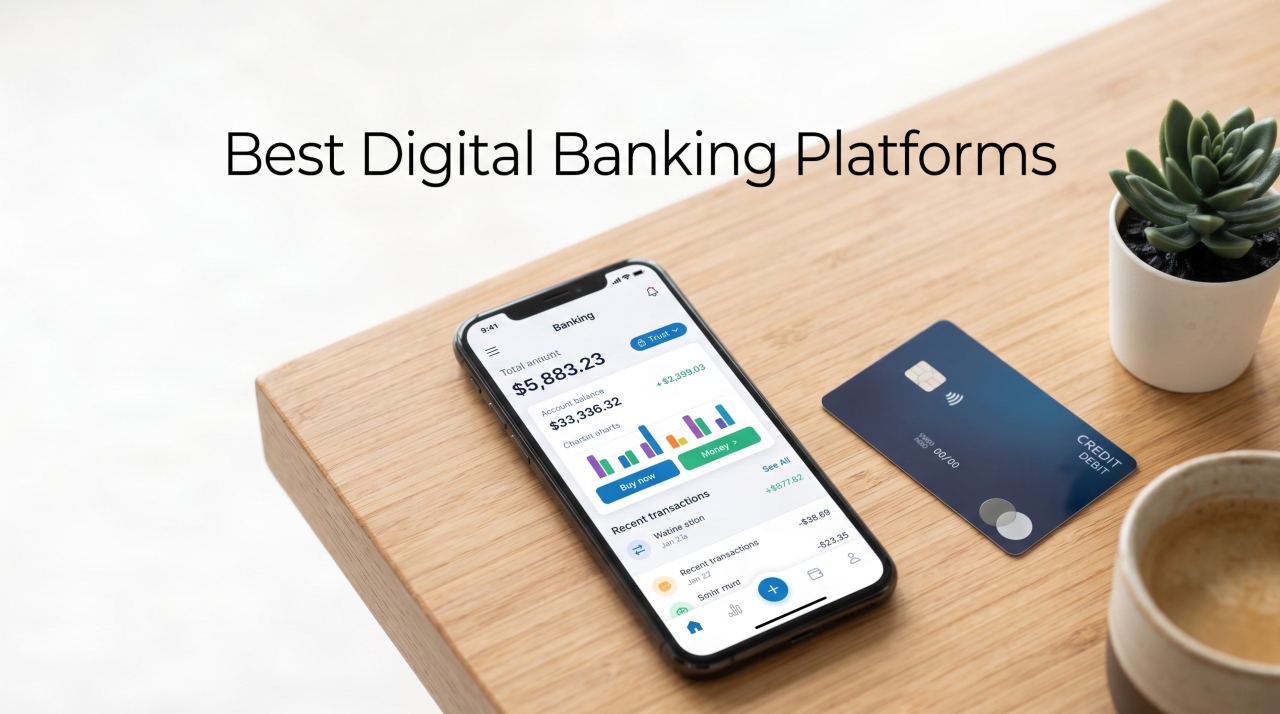
Over 73% of Americans now use digital banking as their primary banking method. Traditional banks are losing more than 1 million customers every month to digital platforms. That’s not a coincidence.
Digital banking platforms give you better interest rates, lower fees, and tools that actually help you save money. No marble lobbies to maintain means more money in your pocket. These online banks work entirely through apps and websites, cutting out the expensive overhead of physical branches.
This guide breaks down the best digital banking platforms available right now. You’ll learn what makes each one special, who should use them, and how to pick the right one for your situation. No promotional nonsense. Just honest comparisons to help you make a smart choice about where to keep your money.
What Makes a Digital Banking Platform Great
A digital banking platform is a bank that operates primarily online without traditional physical branches. You handle everything through a mobile app or website. Your deposits, transfers, bill payments, and customer service all happen digitally.
The best platforms share certain features. Strong security with two factor authentication keeps your money safe. A well designed mobile app makes banking actually easy instead of frustrating. Good customer service means real humans answer when you need help. Low or zero fees let you keep more of your money.
Interest rates matter more than most people realize. Traditional banks often pay 0.01% on savings accounts. Digital banks regularly offer 4% or higher because they spend less on buildings and tellers. That difference adds up fast on your savings.
FDIC insurance is not negotiable. Every legitimate digital bank should have it, protecting your deposits up to $250,000. Check for this before opening any account.
Chime: Best for No Fee Banking
Chime built its reputation on eliminating banking fees completely. No monthly maintenance fees. No overdraft fees. No minimum balance requirements. They make money from transaction fees paid by merchants, not from your pocket.
The SpotMe feature lets you overdraw up to $200 without fees if you set up direct deposit. Your next deposit automatically covers the difference. This helps when unexpected expenses hit before payday.
Chime pays your direct deposit up to two days early. Many users love this feature because bills don’t wait for your official payday. The savings account offers automatic roundups that move spare change from purchases into savings.
The downsides are real though. Chime offers lower interest rates than competitors, usually around 2% compared to 4% or more elsewhere. Customer service can be slow during busy times. You cannot deposit cash easily since there are no branches.
Chime works best for people who live paycheck to paycheck and want to avoid overdraft fees. Students and young workers often find it helpful for building initial savings without pressure.
Ally Bank: Best for High Interest Savings
Ally Bank consistently offers some of the highest interest rates among digital banking platforms. Their savings accounts regularly compete for the top rates, often between 4% and 4.5%. That’s over 100 times what big traditional banks pay.
You get a full range of account types including checking, savings, money market accounts, and CDs. The checking account has no monthly fees and reimburses up to $10 per month in ATM fees from other banks. This basically gives you access to any ATM without worrying about charges.
Their customer service operates 24/7 with real people answering phones. Users consistently rate Ally’s support among the best in banking. The mobile app works smoothly with mobile check deposit, bill pay, and Zelle integration for quick transfers.
The main limitation is no cash deposits. You need to buy a money order or use a workaround if you regularly receive cash. Some users also wish for more physical branch access, though that defeats the purpose of choosing a digital bank.
Ally suits people serious about growing savings through better interest rates. Anyone with a steady income who rarely handles cash will appreciate what Ally offers.
SoFi: Best for All-in-One Financial Services
SoFi started as a student loan company but expanded into a complete financial platform. You can handle banking, investing, loans, and insurance all in one place. This integration helps if you prefer managing everything through a single app.
The checking and savings accounts come with no account fees and competitive interest rates around 4.5%. Members get access to financial advisors at no extra cost. Career coaching and member events add value beyond basic banking.
SoFi offers personal loans, student loan refinancing, mortgages, and credit cards. Having everything connected makes it easier to see your complete financial picture. The rewards program gives cash back and points for various activities.
The catch is that SoFi works best when you use multiple services. Just using the basic checking account means you miss most benefits. Some features require direct deposit to unlock. The platform can feel overwhelming if you only want simple banking.
SoFi fits people who want to consolidate their financial life. Young professionals building wealth appreciate the combination of banking and investment tools.
Marcus by Goldman Sachs: Best for Serious Savers
Marcus focuses heavily on savings rather than offering full banking services. Their high yield savings accounts compete for top rates, usually between 4% and 4.6%. Goldman Sachs backs the platform, bringing serious financial muscle and stability.
You won’t pay any fees. No transaction fees, no transfer fees, no monthly charges. The interface is clean and simple because Marcus doesn’t try to do everything. CDs offer even higher rates if you can lock money away for set periods.
The platform makes moving money easy with quick transfers to and from external accounts. Everything is straightforward without confusing options or hidden requirements. Marcus truly excels at one thing: helping you save money efficiently.
However, Marcus doesn’t offer checking accounts. You need another bank for daily transactions. There’s no mobile check deposit since there are no checking features. Limited services mean this works as a savings companion rather than your only bank.
Choose Marcus when you have money to save and want maximum interest with minimum hassle. People building emergency funds or saving for big purchases find Marcus ideal.
Varo Bank: Best for Credit Building
Varo stands out by offering tools specifically designed to help build credit. The Varo Believe secured credit card reports to all three credit bureaus. You can improve your credit score while banking, something most digital platforms don’t address directly.
The savings account pays competitive interest rates up to 5% when you meet certain requirements like direct deposit and maintaining a minimum balance. Even without meeting those requirements, the base rate stays competitive.
Varo offers cash advances up to $250 with no interest or fees if you qualify. This helps cover emergencies without resorting to expensive payday loans. The app includes budgeting tools and spending insights to help improve financial habits.
The qualification requirements for best features can frustrate some users. You need direct deposit of $1,000 or more to unlock top savings rates and cash advances. Customer service quality varies based on user reports. The platform is still newer and building its reputation.
Varo works well for people actively trying to improve credit scores while managing daily banking. Anyone recovering from past credit problems should consider the credit building features seriously.
Capital One 360: Best for Branch Access Option
Capital One 360 offers a hybrid approach with digital banking plus physical locations. You get online convenience with the option to visit a branch when needed. This bridges the gap between traditional and digital banking.
The checking account has no fees or minimums. Savings accounts offer decent interest rates, though not always the absolute highest. Multiple savings accounts can be created easily to organize money for different goals.
Capital One Cafes provide physical spaces in select cities. You can deposit cash, meet with bankers, or just use the space to work. ATM access is extensive through the Capital One network.
Interest rates typically run slightly lower than pure digital banks. The feature set feels less innovative than newer platforms. Capital One is a massive company, which some people see as safer but others view as less personal.
This platform suits people who want mostly digital banking but occasionally need physical access. Those who travel to cities with Capital One Cafes get extra value.
Current: Best for Teens and Young Adults
Current designed their platform specifically for younger users and families. Teen accounts come with parental controls that let parents monitor spending and set limits. Kids learn money management with real banking tools.
The savings pods feature lets you organize money into different goals. Want to save for a car, vacation, and emergency fund separately? Create a pod for each with custom savings rules. Money automatically moves based on rules you set.
Current pays you up to two days early on direct deposits. The app includes features like instant gas hold refunds and fee free overdrafts up to $200 for eligible members. Building credit becomes possible through their partnership with Credit Karma.
The platform lacks some advanced features that experienced bankers want. Interest rates are lower than competitors. Some features require the premium subscription at $4.99 monthly, though many users find it worthwhile.
Current works perfectly for teenagers getting their first bank account and young adults learning to manage money independently. Parents who want to teach kids about banking while maintaining oversight find this platform valuable.
How to Compare Digital Banking Platforms
Start by listing what matters most to you personally. Do you need high interest rates for savings? Want zero fees on checking? Require easy cash deposits? Your priorities determine which platform fits best.
Ask these key questions about any platform you consider. What are ALL the fees, including rare ones? How quickly can you access your money in emergencies? What happens if you need customer service at midnight? Can you deposit checks easily through the app?
Read reviews but read them smart. Look for patterns in complaints rather than single bad experiences. Check multiple sources including app store reviews and banking forums. Recent reviews matter more than old ones since platforms change.
Test customer service before opening an account. Send a question through their chat or email. See how long responses take and whether answers actually help. This preview shows what you’ll deal with as a customer.
Check FDIC insurance status directly on the FDIC website. Legitimate banks proudly display their FDIC certification. If you can’t easily confirm insurance, that’s a massive red flag.
| Feature | Chime | Ally | SoFi | Marcus | Varo | Capital One 360 | Current |
|---|---|---|---|---|---|---|---|
| Monthly Fees | $0 | $0 | $0 | $0 | $0 | $0 | $0-4.99 |
| Savings Interest | 2% | 4.25% | 4.5% | 4.6% | Up to 5% | 3.9% | 2.5% |
| Minimum Balance | None | None | None | None | None | None | None |
| ATM Access | 60k+ free | All with reimbursement | 55k+ free | None | 55k+ free | Large network | 40k+ free |
| Cash Deposits | Limited | No | Limited | No | Limited | Yes at branches | Limited |
Security Features You Need to Know About
Two factor authentication adds a second step when logging in. You enter your password plus a code sent to your phone or email. This stops most hackers even if they steal your password. Every digital banking platform should offer this.
Biometric login uses your fingerprint or face to access your account. It’s more convenient than typing passwords and actually more secure. Most modern banking apps include these options.
Encryption scrambles your data so criminals can’t read it even if they intercept it. Good digital banks use bank level encryption, the same protection big traditional banks use. You don’t need to understand the technical details, just confirm the bank uses it.
FDIC insurance protects your deposits up to $250,000 if the bank fails. This is government backed protection. Digital banks with FDIC coverage are just as safe as traditional banks. Your money is protected even though there’s no physical vault.
Protect yourself by using strong unique passwords. Never use public WiFi for banking without a VPN. Enable all security features the app offers. Check your account regularly for suspicious activity. Report problems immediately.
Warning signs include apps that crash frequently, difficulty reaching customer service, unclear fee structures, or missing FDIC information. Trust your instincts when something feels wrong.
Real Costs and Fees Breakdown
Monthly maintenance fees are the most obvious cost. Excellent digital banking platforms charge zero monthly fees. Never pay $10 or $15 monthly just to keep your money in an account. That’s $120 to $180 yearly for nothing.
ATM fees come in two types. Your bank might charge you for using ATMs. Other banks that own the ATMs also charge fees. Look for platforms that reimburse ATM fees or have large free ATM networks. Paying $3 every time you need cash adds up absurdly fast.
Overdraft policies vary dramatically between platforms. Traditional banks charge $35 per overdraft. Some digital banks charge nothing. Others offer small fee free overdrafts if you have direct deposit. This single difference can save hundreds yearly.
Wire transfer costs matter if you send money to other people or businesses. Domestic wires can cost $15 to $30 at traditional banks. Many digital platforms include free standard transfers through ACH or Zelle.
Foreign transaction fees hit you when using your debit card internationally. Some banks charge 3% on every foreign purchase. Digital banks often eliminate these fees completely. Travel frequently and this becomes significant.
Hidden fees lurk in fine print. Inactivity fees, paper statement fees, card replacement fees, and account closing fees all exist at some banks. Read the fee schedule completely before opening any account.
Avoid unnecessary charges by setting up direct deposit for fee waivers, maintaining minimum balances when required, using in network ATMs only, and setting up low balance alerts to prevent overdrafts.
Interest Rates and Your Money Growth
Current average savings rates at traditional banks hover around 0.01% to 0.5%. Digital banks offer 4% to 5% regularly. On $10,000 in savings, traditional banks pay you $1 to $50 yearly. Digital banks pay $400 to $500. That’s real money.
Digital banks offer better rates because they have lower costs. No expensive branches to maintain. Fewer employees needed. Those savings get passed to customers through higher interest rates and lower fees.
APY means Annual Percentage Yield. It shows what you actually earn including compound interest. APR is Annual Percentage Rate used for loans. For savings accounts, focus on APY. Higher is always better.
Compound interest means you earn interest on your interest. A 4% APY compounds monthly. Your money grows slightly faster than simple 4% interest. Over years, compound interest creates meaningful differences in savings totals.
Savings accounts let you withdraw money anytime. Money market accounts often pay similar or slightly higher rates. CDs lock your money for set periods like 6 months or 2 years but pay even higher rates.
High yield accounts are simply savings accounts with above average interest rates. Digital banking platforms dominate this category. Moving $10,000 from a 0.01% account to a 4% account earns you an extra $399 yearly.
Set realistic expectations though. Interest rates change based on Federal Reserve decisions. A 4% rate today might be 3% or 5% next year. Even great interest rates won’t make you rich, but they help your savings grow steadily.
Mobile App Features That Matter
Mobile check deposit is essential. You take a photo of a check and it deposits within minutes. Good apps process this smoothly. Bad apps reject photos repeatedly and frustrate you. This feature alone determines how usable a digital bank really is.
Bill pay needs to work simply. You should be able to add payees, schedule payments, and set up recurring bills without confusion. The best apps remember payment history and suggest amounts for regular bills.
Budget tracking tools help some people manage spending. Built in categorization shows where your money goes. Spending alerts warn when you’re approaching limits. Not everyone uses these features, but they add value when done well.
Notification systems keep you informed about your account. Low balance warnings, large transaction alerts, and unusual activity notifications all protect you. Customize notifications to get helpful updates without constant annoying pings.
User interface quality matters more than fancy features. Can you find what you need quickly? Are buttons clearly labeled? Does the app work intuitively? Beautiful design means nothing if you can’t figure out how to transfer money.
App stability separates good from bad platforms. Apps that crash constantly or log you out randomly make banking frustrating. Check app store reviews specifically for mentions of crashes, freezes, or bugs.
Customer Service Reality Check
Response times vary wildly between platforms. Top digital banks answer phone calls in minutes. Others leave you waiting 30 minutes or more. Chat support might respond in seconds or hours. Email support typically takes 24 hours minimum.
Available support channels matter based on your preferences. Some people want phone support. Others prefer chat. Email works fine for non urgent issues. The best platforms offer multiple contact methods and let you choose.
Weekend and holiday availability separates great from good customer service. Financial emergencies don’t wait for business hours. Platforms with 24/7 support provide peace of mind. Limited hour support can leave you stuck when problems hit.
Quality differences show up when you actually need help. Fast answers mean nothing if they don’t solve your problem. Good support representatives understand issues, explain solutions clearly, and follow through until problems are fixed.
Test customer service before fully committing to a platform. Send a simple question through each contact method. Judge response speed and helpfulness. This preview tells you what dealing with real problems will feel like.
Escalation processes should be clear when frontline support can’t help. Can you reach a supervisor easily? Is there a formal complaint process? Knowing these paths exist helps when serious issues arise.
Making the Switch from Traditional Banking
Start by opening your new digital banking account while keeping your old account active. This prevents problems if something goes wrong during transition. Running both accounts in parallel for a month makes switching safer.
Update direct deposits with your employer first. Give yourself one full pay cycle to confirm everything works correctly. Most employers need two weeks notice to change bank information. Some payroll systems move slower.
List all automatic payments and subscriptions tied to your old account. Update each one individually to your new account information. This takes time but prevents missed payments. Utility companies, streaming services, gym memberships, and loan payments all need updating.
Transfer most of your money to the new account but leave enough in the old account to cover any automatic payments you missed. Keep the old account open for 60 days minimum to catch straggler transactions.
Common switching mistakes include closing old accounts too quickly, forgetting about annual subscriptions, not keeping records of account numbers, and assuming all transfers complete instantly. Take your time and double check everything.
Close old accounts only after confirming no pending transactions and no automatic payments remain. Request written confirmation of account closure. Some banks charge dormant account fees if you leave accounts empty but open.
Special Considerations for Different Users
Freelancers and gig workers deal with irregular income from multiple sources. Choose platforms with good mobile deposit since you might receive checks from various clients. Savings features that automatically set aside money for taxes help immensely. Accounts with no minimum balance requirements work better when income fluctuates.
Students benefit from platforms designed for younger users with lower balances. Credit building features help establish financial history early. Low or zero fees matter more when working part time or relying on student loans. Early direct deposit access helps when money is tight.
Families need joint account options and possibly teen accounts with parental controls. Shared access to accounts helps partners manage household expenses together. Some platforms offer family plans or special features for managing multiple accounts under one login.
Retirees living on fixed incomes prioritize easy access and security over high tech features. Clear interfaces matter more than flashy apps. Excellent customer service with phone support becomes crucial. Some older users prefer hybrid banks that still offer occasional branch access.
Common Problems and Solutions
Technical issues happen with every digital platform sometimes. Apps crash, websites go down, or features stop working. Keep customer service contact information saved outside the app. Having backup access to money through a second account helps during outages.
Deposit delays frustrate users when money doesn’t appear instantly. Mobile check deposits typically clear within one business day but can take longer. ACH transfers take two to three business days normally. Know these timelines and plan accordingly.
ATM access limitations affect digital bank users more than traditional bank customers. Not all ATMs work with all cards. Finding free ATMs in unfamiliar areas takes extra effort. Apps usually include ATM locators to help.
Cash deposit workarounds are necessary since digital banks lack branches. Options include depositing cash at retail partners, buying money orders, or keeping a minimal traditional bank account solely for cash deposits.
Customer service complaints often involve long wait times or unhelpful responses. Escalate issues when initial support fails. Social media complaints sometimes get faster attention. Keep records of all communication about problems.
Account freezes for suspected fraud protect you but cause stress when you need money. These usually resolve within 24 hours after identity verification. Keep alternative payment methods available for emergencies.
App crashes during critical moments are infuriating. Always have customer service numbers saved. Most platforms offer website access as backup. Update apps regularly since many crashes come from outdated software.
The Future of Digital Banking
Cryptocurrency integration is expanding slowly. Some digital banks now allow buying and selling crypto directly through banking apps. This trend will likely continue as crypto becomes more mainstream. Regulation will determine how quickly this develops.
AI powered features are appearing in smarter chatbots, personalized savings recommendations, and fraud detection. Expect apps to become more proactive in helping manage money. These features improve when done well but can feel intrusive when overdone.
Improved security measures continue developing. Behavioral biometrics track how you use your phone to detect fraud. Advanced encryption protects data better. Security will always be an arms race between banks and criminals.
Open banking concepts let you share financial data between different apps and services securely. This creates opportunities for better financial management tools. You might grant your budgeting app safe access to banking data.
Expect consolidation in the next two years as smaller digital banks merge or get acquired. More traditional banks will improve digital offerings to compete. The lines between digital and traditional banking will continue blurring.
Stay informed by following financial news and checking for app updates regularly. Digital banks communicate changes through email and app notifications. Read these updates instead of ignoring them.
Frequently Asked Questions
Is my money safe in a digital bank?
Yes, if the bank has FDIC insurance. Your deposits are protected up to $250,000 just like traditional banks. Digital banks follow the same regulations and security standards.
Can I deposit cash with online banking?
Most digital banks have limited cash deposit options. Some partner with retailers like Walmart or CVS. Others require workarounds like money orders. This is the biggest limitation of digital banking.
What happens if the platform shuts down?
FDIC insurance protects your money if an insured bank fails. You’ll receive your funds up to the insured limit. The FDIC handles this process and typically gets money to customers quickly.
How fast can I access my money?
Debit card purchases and ATM withdrawals work instantly. Transfers to external banks take one to three business days. Some platforms offer instant transfers for fees. Emergency access is generally not a problem.
Do digital banks report to credit bureaus?
Most digital banks don’t report regular checking and savings accounts to credit bureaus. Some offer credit building products that do report. Check specific features if building credit matters to you.
Can I get a mortgage or car loan?
Some digital banking platforms offer loans. Others focus only on deposit accounts. You can absolutely get loans elsewhere while using a digital bank for daily banking.
Are there age requirements?
Most digital banks require you to be 18 or older to open accounts independently. Some platforms offer teen accounts with parental oversight. Requirements vary by platform.
What if I need help with my account?
Digital banks provide customer service through phone, chat, and email. Quality varies significantly between platforms. Some offer 24/7 support while others have limited hours.
Conclusion
Digital banking platforms offer real advantages over traditional banks. Better interest rates grow your savings faster. Lower fees keep more money in your account. Convenient apps make banking easier when done right.
The top recommendations depend on your situation. Chime works for fee avoiders. Ally suits serious savers. SoFi helps people wanting all in one services. Marcus maximizes interest on savings. Varo builds credit. Capital One 360 bridges digital and physical banking. Current serves teens and young adults well.
Remember that FDIC insurance is your safety guarantee. Never open accounts with platforms lacking clear FDIC coverage. Your money deserves proper protection.
Compare at least three platforms before deciding. Your banking needs are unique. What works perfectly for someone else might frustrate you. Take time to match features with your priorities.
Security awareness protects you regardless of which platform you choose. Enable two factor authentication. Use strong passwords. Monitor accounts regularly. Report problems immediately.
Open an account with the platform that matches your needs best. Start with no fee options to test digital banking without risk. Give yourself 30 days to experience how it actually works for your life. You can always adjust or switch if the first choice doesn’t fit perfectly.
The banks holding your money should work for you, not the other way around. Digital banking platforms make that possible when you choose wisely.