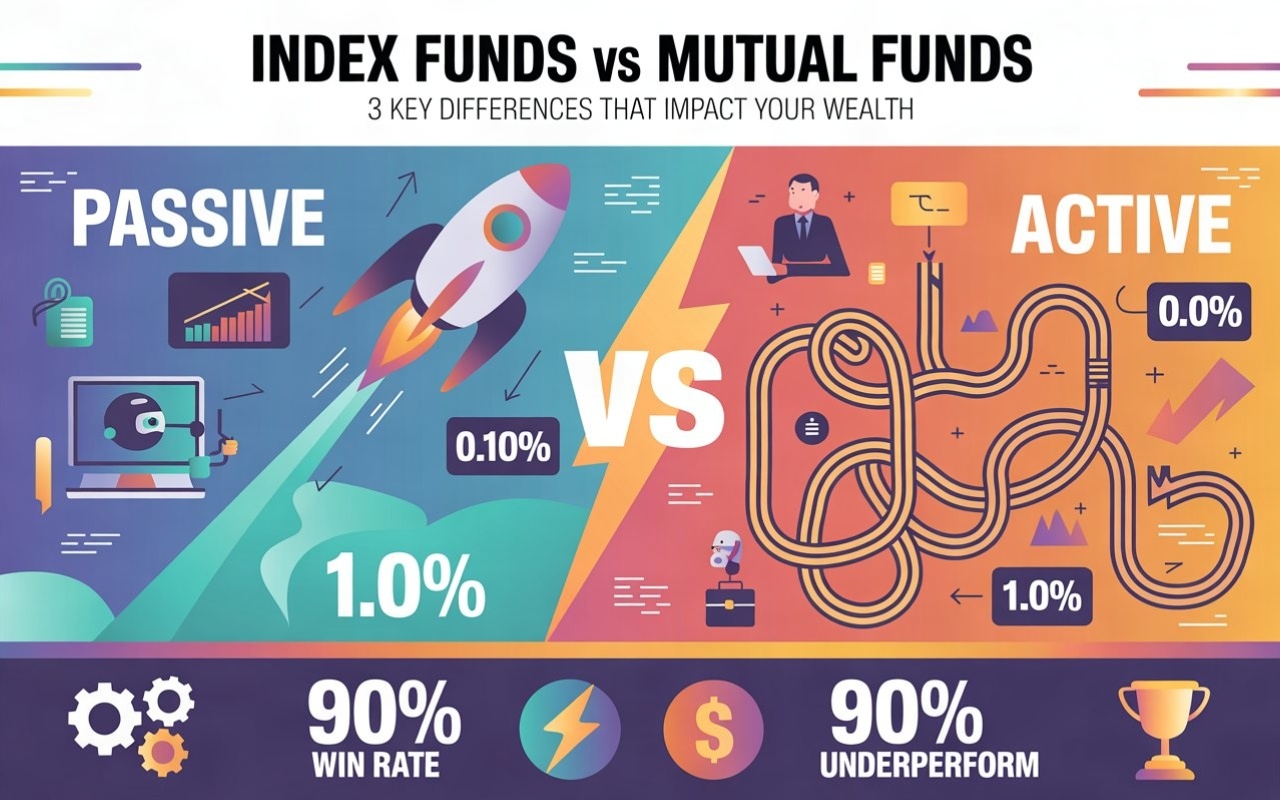
Over 90% of actively managed mutual funds fail to beat their benchmark index over 15 years, according to S&P Dow Jones Indices. This single fact explains why millions of investors are switching to index funds. Yet many people still don’t understand the real differences between index funds and mutual funds.
Both types of investments can help you build wealth. Both let you own pieces of many companies at once. Both are sold by major financial companies you’ve heard of. So what makes them different, and why should you care?
The answer comes down to three main things: how they’re managed, what they cost, and how they actually perform. These differences directly affect how much money ends up in your pocket decades from now.
This article breaks down each difference in plain English. You’ll learn which type saves you money, which requires less work, and which has the better track record. Whether you’re just starting to invest or rethinking your current strategy, you’ll finish reading with a clear picture of which option makes sense for you.
What Are Index Funds and Mutual Funds?
Before we get to the differences, let’s make sure we’re on the same page about what these investments actually are.
A mutual fund is a pool of money from many investors. A professional fund manager decides which stocks or bonds to buy. The manager’s job is to pick investments that will beat the overall market. They spend their days researching companies, analyzing trends, and making trades. When you buy into a mutual fund, you’re paying for this expertise.
An index fund is also a pool of money from many investors. But there’s no manager trying to beat the market. Instead, the fund simply copies a market index like the S&P 500. If the index includes 500 companies, the fund buys all 500 in the same proportions. Computers handle most of the work.
Both types offer important benefits. They let you own hundreds of stocks with a single purchase. They spread your risk across many companies. They’re regulated by the government to protect investors. You can buy either one through your retirement account at work or a regular investment account.
The similarities end there. Now let’s look at what sets them apart.
Difference #1: How They’re Managed Changes Everything
The biggest difference between index funds and mutual funds is how they’re run. This affects everything else.
Mutual funds use active management. A fund manager and their team constantly make decisions about what to buy and sell. They read financial reports, meet with company executives, and analyze economic trends. They’re trying to find stocks that will go up more than average and avoid stocks that will go down. The manager might hold 50 stocks or 200 stocks, whatever they think will win.
This sounds great in theory. Smart people with fancy degrees studying the market all day should be able to beat it, right? That’s what you’re paying for when you invest in an actively managed mutual fund.
Index funds use passive management. There’s no team of analysts. No one is trying to outsmart the market. The fund follows a simple rule: own the same stocks as the index you’re tracking. If you buy an S&P 500 index fund, you own pieces of all 500 companies in that index. The fund only makes changes when the index itself changes, which doesn’t happen often.
Why does this management difference matter to you? It comes down to costs and odds. Active management requires paying salaries for managers, analysts, and researchers. It means more trading, which creates transaction costs. All of these expenses come out of your returns. Passive management needs far fewer people and makes far fewer trades, so costs stay low.
Here’s a real world example. Sarah invests in an actively managed mutual fund. Every quarter, she sees her fund bought and sold dozens of stocks. Sometimes the manager was right, sometimes wrong. Sarah has no control over these decisions. She just hopes the manager knows what they’re doing.
Mike invests in an S&P 500 index fund. His fund owns the same 500 companies quarter after quarter. When one company grows, his fund automatically owns more of it. When another shrinks, he automatically owns less. Mike doesn’t worry about whether his fund manager is smart enough because there’s no manager to worry about.
The active approach feels exciting. The passive approach feels boring. But as we’ll see, boring often wins in investing.
Difference #2: Fees Can Make or Break Your Wealth
This is where the difference between index funds and mutual funds really hits your wallet.
Every fund charges fees. The main fee is called the expense ratio. It’s a percentage of your money that the fund takes each year to cover operating costs. This money gets taken automatically, so you never write a check. You just earn less than you would otherwise.
Mutual funds typically charge expense ratios between 0.5% and 2% per year. Some charge even more. The average actively managed stock mutual fund charges about 1% annually. That might not sound like much, but let’s do the math.
If you invest $10,000 and it grows at 8% per year for 30 years, you’d have about $100,627 with no fees. With a 1% annual fee, you’d have about $74,395. That 1% fee cost you over $26,000. The fund company got that money instead of you.
Index funds typically charge between 0.03% and 0.20% per year. Many large index funds charge less than 0.10%. Some of the biggest charge just 0.03%. Using our same example with a 0.10% fee, you’d end up with about $97,455. You keep almost all your gains.
The difference between paying 1% and paying 0.10% might seem small. Over decades, it’s enormous. On a $10,000 investment over 30 years, that difference is about $23,000. If you’re investing consistently over those 30 years, the gap gets even bigger.
Mutual funds also sometimes charge other fees. Load fees are sales charges, either when you buy or sell. Some charge 5% or more. So if you invest $10,000, only $9,500 actually gets invested. Index funds rarely charge load fees.
There are also 12b-1 fees for marketing and distribution, and transaction costs from all that trading. These nibble away at your returns too. Index funds have minimal extra fees because they do minimal trading.
Why do mutual funds cost so much more? Remember that team of managers and analysts? They need salaries. All that research costs money. Frequent trading means paying commissions and spreads. Marketing the fund to attract investors costs money. Active management is expensive.
Index funds need a computer and a few people to make sure the fund matches its index. That’s about it. Passive management is cheap.
Here’s what smart investors do. Before buying any fund, they check the expense ratio. It’s listed in every fund’s prospectus and on financial websites. They compare similar funds. They understand that while returns can vary, fees are guaranteed. Every year, you will pay that expense ratio, whether the fund goes up or down.
Lower fees mean more money stays invested and compounds over time. This might be the single most important factor in building wealth through investing. The fund industry doesn’t advertise this fact much, but the data is clear.
Difference #3: Performance History Tells a Clear Story
Now we get to the results. Do mutual funds justify their higher fees with better performance?
The data says no. According to the SPIVA scorecard, which tracks this carefully, about 85% of actively managed mutual funds underperform their benchmark index over 10 years. Over 15 years, that number rises above 90%. Read that again. Nine out of ten mutual funds fail to beat the simple index they’re trying to beat.
This isn’t a recent trend. It’s been true for decades. The numbers get worse the longer you look. Over one year, maybe half of mutual funds beat their index. Over five years, about 75% fall behind. Over 15 years, more than 90% lose the race.
Why do mutual funds perform so poorly? The main reason is fees. Even if a fund manager picks stocks that match the market before fees, the fees push performance below the market. A fund charging 1% needs to beat the market by 1% just to break even. That’s harder than it sounds.
Trading costs hurt too. Every time a mutual fund buys or sells a stock, there are costs. Bid ask spreads, commissions, and market impact all chip away at returns. Index funds trade rarely, so these costs stay tiny.
There’s also something called survivorship bias. When a mutual fund performs terribly, the company often closes it and merges it into another fund. Those failures disappear from the performance records. The statistics you see only include the funds that survived. The real numbers are even worse than reported.
Index funds, by design, match their index. If the S&P 500 goes up 10%, your S&P 500 index fund goes up about 10% minus a tiny fee. You won’t beat the market, but you won’t fall behind either. You get what the market gives.
Here’s why that’s actually great news. The U.S. stock market has returned about 10% annually over the long term. An index fund charging 0.10% gives you about 9.9% per year. A mutual fund needs to pick stocks so well that it overcomes its 1% fee and still beats 9.9%. Very few managers can do this consistently.
Let’s look at two retirement savers. Both start with nothing and invest $500 monthly for 30 years. Both earn 8% before fees on their investments.
Investor A uses mutual funds with a 1% average expense ratio. After 30 years, she has about $566,000.
Investor B uses index funds with a 0.10% expense ratio. After 30 years, he has about $679,000.
Same contribution, same market returns, but Investor B has $113,000 more. That’s the power of lower fees and matching market performance instead of trying to beat it.
Some mutual funds do beat the market. A handful of managers have impressive long term records. But picking these winners ahead of time is nearly impossible. Past performance doesn’t predict future results. A fund that beat the market for five years often falls behind the next five years. The manager might leave. The strategy might stop working. You’re basically gambling that you found the rare exception.
With index funds, you don’t need to find the exception. You accept that you’ll get average market returns, which turns out to beat most of the professionals trying to do better.
Which One Should You Choose?
For most people, most of the time, index funds make more sense. The evidence is overwhelming. Lower fees, consistent performance, and simplicity create a winning combination.
Index funds work especially well for retirement savings, long term goals, and investors who want to spend less time managing their money. If you’re saving for retirement 20 or 30 years away, index funds let you capture market growth while keeping more of your returns.
That said, mutual funds can make sense in specific situations. If you need exposure to a specialized sector not well covered by indexes, an actively managed fund might be your only option. Some investors have specific ethical or religious requirements that specialized mutual funds address. A few people genuinely enjoy active involvement in investment decisions.
Some investors use both. They build a core portfolio of low cost index funds, then add a small allocation to specific mutual funds for particular purposes. This approach gives you the benefits of indexing while allowing some active choices.
What do investment experts say? Warren Buffett, one of history’s most successful investors, has repeatedly recommended index funds for most people. His advice for the money he’s leaving his wife is simple: put it in a low cost S&P 500 index fund. If that’s good enough for Warren Buffett’s family, it’s worth considering for yours.
The practical choice comes down to this. If you want to pay less, get consistent returns, and keep investing simple, index funds win. The three differences we covered all point the same direction.
Common Myths and Misconceptions
Let’s clear up a few things you might have heard.
Myth number one: You need mutual funds to beat the market and get rich. The truth is most mutual funds don’t beat the market. Getting rich from investing comes from consistent saving and letting compound growth work over decades. Index funds do that job wonderfully.
Myth number two: Index funds are only for lazy investors. Actually, choosing simple, effective investments is smart, not lazy. Why make investing harder than it needs to be? Complexity doesn’t equal better results.
Myth number three: Higher fees mean better management. This is backwards. Higher fees mean you keep less money. The data shows expensive funds usually underperform cheap ones. You’re paying more to get less.
Myth number four: Index funds can’t make you wealthy. The stock market has created enormous wealth for patient investors. Index funds capture that growth while charging minimal fees. Plenty of millionaires built their wealth through simple index fund investing.
The Bottom Line
Let’s recap the three key differences between index funds and mutual funds.
First, management style. Mutual funds use active management with professional stock pickers trying to beat the market. Index funds use passive management, simply matching a market index. Active sounds better but usually isn’t.
Second, fees. Mutual funds typically charge 0.5% to 2% annually plus other fees. Index funds usually charge under 0.20%, often much less. This difference compounds into hundreds of thousands of dollars over a lifetime.
Third, performance. Most mutual funds underperform their benchmark index over time. Index funds match their benchmark by design, which ends up beating most active funds.
All three differences favor index funds for the majority of investors. Your choice today affects your wealth decades from now. The investor who pays 1% in fees instead of 0.10% is giving away a huge portion of their future wealth.
Investing doesn’t have to be complicated. Sometimes the simple choice is the smart choice. The evidence clearly shows that low cost index funds work for most investors. You don’t need to find the perfect mutual fund manager or time the market perfectly. You just need to own a broad slice of the market, keep costs low, and stay invested.
Take Action Today
Here’s what to do next. Pull out your investment statements right now. Look at every fund you own. Find the expense ratio for each one. It should be listed on your statement or easily found online by searching the fund name.
Add up how much you’re paying in fees each year. Multiply your total invested amount by the expense ratio percentage. That’s real money coming out of your pocket annually.
Next, check if your mutual funds have actually beaten their benchmark index after fees. Most statement websites show this comparison. If your funds are underperforming and charging high fees, you have your answer.
Consider whether those fees are worth what you’re getting. If you’re paying 1% for a fund that’s underperforming a 0.10% index fund, you’re losing money twice.
Talk to a financial advisor if you’re unsure about making changes. Many employers offer free financial advice through their retirement plans. You can also consult a fee only financial planner who doesn’t earn commissions from selling you specific funds.
Start with one small change if you’re overwhelmed. Maybe move your next contribution into a low cost index fund instead of your current mutual fund. You don’t have to sell everything at once.
Look at your investment statements today. Find the expense ratio. Ask yourself if those fees are worth what you’re getting. That’s where smart investing starts.