
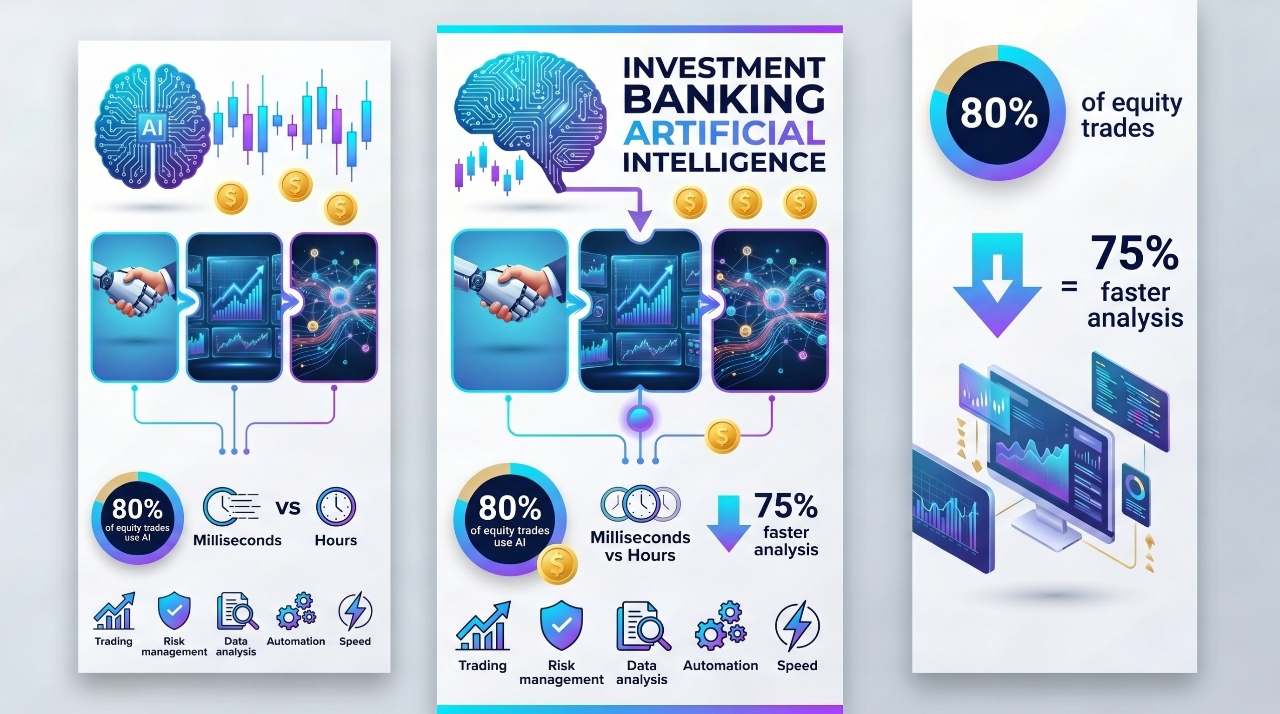
Investment banks now process over 80% of equity trades using artificial intelligence systems, handling billions of dollars in milliseconds that once took human traders hours to complete. This shift happened fast, and it affects everyone who invests money or works in finance.
Investment banking artificial intelligence means computers that learn and make decisions about money, trades, and investments without constant human input. These systems analyze massive amounts of data, spot patterns, and execute complex financial tasks faster than any person could. This matters because it makes banking cheaper, faster, and often more accurate. Your investments get managed better, trades happen quicker, and banks can offer services that cost less.
You will learn how AI works in investment banks, what tasks it handles best, and how this technology changes the way your money gets managed. We will look at real examples from major banks, discuss honest limitations, and explore what comes next. Whether you invest money, work in finance, or just want to understand where banking is headed, this information helps you make smarter decisions.
What Investment Banking Artificial Intelligence Actually Does
The Basics Explained Simply
Think of AI as a computer program that gets smarter over time. Regular programs follow strict rules someone wrote. AI programs learn from examples and improve their performance without new programming. A traditional banking program might flag transactions over $10,000, but an AI system learns what normal looks like for each customer and spots unusual activity based on patterns.
Investment banking artificial intelligence examines thousands of data points simultaneously. It recognizes relationships between different pieces of information that humans might miss. The system gets better at its job by processing more examples, similar to how you get better at recognizing faces the more people you meet.
Main Tasks AI Handles in Investment Banks
AI now manages several core banking functions. Trading systems buy and sell securities automatically based on market conditions and programmed strategies. Research tools scan financial documents, news articles, and market data to generate investment insights. Risk management platforms monitor portfolios constantly to catch potential problems early.
Client service gets handled partly by AI chatbots that answer questions and process routine requests. Document processing systems read contracts, extract important terms, and flag issues for human review. Fraud detection monitors millions of transactions to spot suspicious patterns. Each task benefits from AI’s speed and consistency.
How AI Makes Trading Faster and Smarter
Algorithmic Trading Explained
AI trading systems watch market prices, volume, news, and dozens of other factors every second. When conditions match the strategy programmed into the system, it executes trades automatically. These programs can analyze a company’s earnings report, compare it to expectations, check the current stock price, and place a trade before a human finishes reading the first paragraph.
Speed gives AI traders a real advantage. Markets move fast, and prices change in fractions of a second. Human traders need time to think, type, and confirm orders. AI completes the entire process almost instantly. This speed means better prices and more profit opportunities. Accuracy improves too because computers do not make typing errors or forget to check important factors.
High Frequency Trading
Some investment banking artificial intelligence systems make thousands of trades per second. They profit from tiny price differences that exist for just moments. A stock might sell for $50.00 on one exchange and $50.01 on another. AI spots this gap and makes trades to capture that penny difference. Do this millions of times daily, and those pennies add up to serious money.
These systems handle trading volumes no human team could manage. A single AI platform might execute more trades in one hour than a traditional trading desk processes in a month. The Securities and Exchange Commission monitors these activities to ensure markets stay fair and stable.
Pattern Recognition in Markets
AI excels at finding patterns in historical data. It looks at how stocks behaved during past earnings seasons, economic announcements, or market crashes. The system identifies conditions that preceded big price movements and watches for similar setups. This helps predict what might happen next, though predictions are never perfect.
Markets change constantly, and good AI systems adapt. They notice when old patterns stop working and adjust their strategies. A pattern that predicted stock movements in 2020 might fail in 2024 due to different economic conditions. Smart systems recognize this and modify their approach without human intervention.
AI Transforms Research and Analysis Work
Reading and Processing Documents
Investment banks deal with mountains of paperwork. Annual reports, quarterly filings, merger documents, and research papers pile up fast. AI reads these documents in seconds and pulls out key facts. It finds revenue numbers, identifies risks mentioned by management, and compares current results to past performance.
A human analyst might spend all day reading one detailed merger agreement. AI scans it in minutes, highlighting important terms, unusual clauses, and potential problems. The system can process every filing from every company in an industry overnight. This gives analysts better information faster, letting them focus on interpretation instead of data collection.
Financial Modeling Gets Easier
Building financial models used to take hours or days. You gather data, build spreadsheets, check formulas, and run scenarios. Investment banking artificial intelligence automates much of this work. Feed the system basic information about a company, and it builds comprehensive models showing projected revenues, costs, and profits under different conditions.
These AI systems run hundreds of scenarios simultaneously. What happens if interest rates rise two percent? What if sales grow slower than expected? What if a key supplier raises prices? Traditional analysts test these scenarios one at a time. AI tests them all at once and ranks outcomes by likelihood. This helps banks make better lending and investment decisions.
Better Investment Recommendations
AI removes some human biases from investment analysis. People get attached to companies they like or avoid sectors they do not understand. AI evaluates everything using the same criteria. It does not care if a company makes boring products or has an annoying CEO. The numbers either support an investment or they do not.
Continuous monitoring gives AI another advantage. Human analysts check on investments periodically, maybe weekly or monthly. AI watches them constantly. If something important changes, the system notices immediately and can alert investors or adjust positions. This fast response prevents small problems from becoming big losses.
Risk Management Becomes More Accurate
Spotting Problems Before They Happen
Investment banking artificial intelligence monitors risk across entire portfolios. It tracks how much money gets exposed to each industry, country, or type of investment. When concentrations get too high, the system warns managers before trouble starts. Early warnings give banks time to adjust positions and reduce danger.
Credit risk analysis improves with AI. The systems examine borrower finances, payment history, economic conditions, and many other factors to predict default probability. They spot warning signs like declining cash flow or increasing debt loads faster than traditional analysis. This helps banks avoid bad loans and protect their capital.
Compliance and Regulatory Monitoring
Banks must follow thousands of rules about what they can trade, how they report transactions, and what information they must disclose. AI systems check every trade and transaction against these rules automatically. They catch violations before they happen and create audit trails showing compliance.
Suspicious activity detection uses AI to spot potential money laundering or fraud. The systems learn normal patterns for different types of accounts and transactions. When something looks odd, they flag it for investigation. This protects banks from criminals and helps them meet legal reporting requirements. The Federal Reserve provides guidance on using AI for these purposes responsibly.
Fraud Prevention
AI fraud detection examines millions of transactions daily looking for red flags. Unusual transfer amounts, strange timing, new beneficiaries, or geographic anomalies all trigger alerts. The system learns what normal looks like for each client and notices deviations. A wire transfer to a new country might be routine for an import company but suspicious for a retiree.
Identity verification uses AI to confirm that clients are who they claim to be. Facial recognition, voice analysis, and behavior patterns all help confirm identity. These systems make fraud harder while keeping legitimate transactions smooth and quick.
Client Services Get Personal and Quick
Chatbots and Virtual Assistants
Many banks now offer AI powered chatbots that answer client questions any time of day. These systems handle common requests like account balances, recent transactions, or statement copies. They process simple transactions like transfers between accounts or bill payments. Clients get instant service without waiting for business hours.
More sophisticated systems answer complex questions about investment performance, tax reporting, or account features. They learn from each interaction and improve their responses over time. When questions exceed the AI’s ability, it transfers clients smoothly to human advisors with context about the issue.
Personalized Investment Advice
Investment banking artificial intelligence creates customized recommendations based on individual client situations. It considers your age, income, risk tolerance, goals, and timeline. The system suggests specific investments and adjusts recommendations as your situation changes. Getting married, having children, or approaching retirement all trigger strategy updates.
Regular monitoring ensures advice stays current. AI reviews your portfolio constantly and suggests adjustments when needed. Market changes, new opportunities, or shifts in your personal situation all factor into updated recommendations. This personalized attention used to require expensive human advisors but now reaches more people at lower cost.
Real Cost Savings for Banks and Clients
Investment banking artificial intelligence cuts operational costs dramatically. Tasks that required teams of analysts now need just a few people overseeing AI systems. A due diligence review that took 40 hours shrinks to 2 hours. Trade execution drops from minutes to milliseconds. Risk reports that consumed 8 hours now finish in 30 minutes.
Error rates fall sharply because computers follow processes consistently. Human analysts make mistakes when tired, distracted, or rushing. AI maintains the same quality on the millionth task as the first. Fewer errors mean less money lost to corrections, penalties, or missed opportunities.
Deal processing speeds up significantly. Mergers, acquisitions, and underwriting move faster when AI handles document review and analysis. Faster deals mean banks complete more transactions with the same staff. This efficiency boosts revenue while controlling costs.
| Process | Traditional Time | AI Time | Cost Reduction |
|---|---|---|---|
| Due diligence review | 40 hours | 2 hours | 75% |
| Trade execution | Minutes | Milliseconds | 60% |
| Risk report generation | 8 hours | 30 minutes | 85% |
These savings get passed partly to clients through lower fees and better pricing. Competition forces banks to share efficiency gains. Clients benefit from cheaper trades, lower management fees, and reduced transaction costs.
Major Investment Banks Using AI Right Now
Goldman Sachs AI Initiatives
Goldman Sachs transformed its trading operations with AI. The company once employed hundreds of traders on its New York stock trading desk. Now just a few people oversee automated systems that handle most trades. These systems process orders faster and cheaper than human traders could.
Marcus, Goldman’s consumer banking platform, uses AI to evaluate loan applications and manage customer accounts. The technology lets Goldman serve retail customers profitably despite lower account balances than traditional private banking clients. Risk management systems powered by AI monitor the entire firm’s exposure across all trading activities.
JPMorgan Chase Technology
JPMorgan developed COiN, a contract intelligence platform that reviews commercial loan agreements. This system does in seconds what took lawyers 360,000 hours annually. It extracts key data points, identifies unusual terms, and flags potential issues. The accuracy matches or exceeds human review while costing a fraction as much.
LOXM, their AI trading system, executes equity trades by determining optimal timing and pricing. It learns from each trade to improve performance continuously. Document intelligence systems process the millions of pages of paperwork flowing through a major bank daily. You can learn more about JPMorgan’s technology initiatives on their corporate website.
Morgan Stanley and Other Leaders
Morgan Stanley uses its Next Best Action system to help financial advisors serve clients better. The AI analyzes client data and suggests timely actions like rebalancing portfolios or adjusting strategies. Wealth management tools help advisors manage more clients without sacrificing service quality.
Other major banks all invest heavily in similar technologies. Bank of America, Citigroup, and Deutsche Bank each spend billions developing and deploying investment banking artificial intelligence. No major player can compete effectively without these tools anymore.
Challenges and Limitations You Should Know
Things AI Still Cannot Do Well
Investment banking artificial intelligence struggles with truly unusual situations. When markets behave in ways they never have before, AI systems trained on historical data may fail. The 2020 pandemic crash included price movements and correlations that had never occurred. Some AI systems made poor decisions because they had no relevant training data.
Judgment calls in gray areas remain difficult for AI. Should a bank finance a controversial project? How much risk is appropriate for a specific client? These questions involve values, relationships, and considerations beyond pure data analysis. Humans still make these decisions better.
Client relationships require emotional intelligence AI lacks. Building trust, understanding unstated concerns, and providing reassurance during market stress all need human skills. Creative deal structuring also remains a human strength. Imagining new ways to finance a merger or structure a complex transaction requires innovation computers do not possess.
Technical Problems
Data quality issues cause AI failures. These systems learn from data, so bad data produces bad results. If historical data contains errors, biases, or gaps, the AI inherits those flaws. Garbage in, garbage out applies fully to artificial intelligence.
System failures happen despite extensive testing. Software bugs, hardware problems, or unexpected interactions between different systems can cause crashes or errors. When AI controls millions of dollars in trades, even brief failures create serious problems. Banks maintain backup systems and human oversight to limit damage.
Cybersecurity risks grow as banks depend more on AI. Hackers target these systems because compromising them could be extremely profitable. A corrupted AI trading system could be manipulated to move markets or lose money intentionally. Banks invest heavily in security but the threat never disappears.
Integration with old systems creates headaches. Many banks run core processes on software written decades ago. Making new AI tools work with ancient mainframe systems is difficult and expensive. This slows AI adoption and limits what banks can accomplish.
Ethical and Fair Use Concerns
Algorithmic bias poses real dangers. If AI systems train on historical data reflecting past discrimination, they might perpetuate those biases. A lending AI trained on decades of loan decisions might discriminate against certain groups because past human lenders did. Banks must test systems carefully and monitor for unfair outcomes.
Job displacement worries many people. Investment banking artificial intelligence eliminates some roles while creating others. Junior analysts and traders face fewer opportunities as AI handles their traditional work. New jobs emerge in data science, AI training, and system oversight, but they require different skills. This transition creates real hardship for some workers.
Privacy questions arise as AI systems collect and analyze vast amounts of personal data. How much information should banks gather? How long should they keep it? Who can access it? These questions lack clear answers, and regulations struggle to keep pace with technology.
Market manipulation potential exists when powerful AI systems trade against each other. Could coordinated AI trading destabilize markets? Might sophisticated systems exploit weaknesses in other algorithms? Regulators monitor these risks but worry about scenarios they have not imagined yet.
What Happens to Human Bankers
Some traditional banking roles shrink or disappear. Junior traders, basic analysts, and routine processing jobs face automation. Tasks involving repetitive analysis or simple decision making shift to AI systems. Entry level positions that once trained young bankers become less common.
New jobs emerge around AI development, oversight, and strategy. Banks need data scientists to build and improve AI systems. They need specialists who understand both banking and technology. Compliance officers must learn how to audit and regulate AI decisions. These roles often pay well but require different skills than traditional banking.
Skills bankers need change significantly. Technical literacy becomes essential even for senior positions. Understanding what AI can and cannot do helps managers use these tools effectively. Interpersonal skills grow more valuable as routine analytical work gets automated. Relationship building, creative problem solving, and strategic thinking matter more than ever.
Working alongside AI systems becomes the norm rather than the exception. Bankers learn to use AI tools as assistants that handle data processing and routine analysis. They focus on interpretation, strategy, and client relationships. The best performers combine human judgment with AI capabilities.
Training and education adapt to this new reality. Business schools teach AI fundamentals alongside traditional finance. Banks invest in retraining existing employees. Professional development focuses on skills that complement rather than compete with artificial intelligence.
Government Rules and Regulations
Current regulations cover AI use in banking only partially. Existing rules about fair lending, data privacy, and market manipulation apply to AI systems, but specific AI regulations remain limited. Banks must ensure their algorithms do not discriminate and their trading does not manipulate markets. Beyond these basic requirements, detailed AI rules are still developing.
Transparency requirements are increasing. Regulators want to understand how AI systems make decisions, especially for important functions like lending or risk management. Banks must document their AI models, explain how they work, and demonstrate that outcomes are fair. This “explainability” proves challenging with complex AI systems.
Testing and validation rules ensure AI systems work as intended. Banks must prove their systems are accurate, reliable, and safe before deployment. Ongoing monitoring catches problems that emerge over time. Stress testing shows how AI performs under unusual or extreme conditions. These requirements add costs but prevent dangerous failures.
Cross border considerations complicate AI regulation. A bank operating globally must comply with different rules in each country. European privacy laws differ from American regulations. Asian markets have their own requirements. Creating AI systems that satisfy all jurisdictions simultaneously is complex and expensive. The Financial Stability Board works on international coordination.
Future regulations will likely expand significantly. Expect more detailed rules about AI testing, monitoring, and accountability. Requirements for human oversight and intervention capabilities will grow. Penalties for AI system failures or biases will increase. Banks preparing for stricter regulation position themselves better than those assuming rules will stay loose.
Where Investment Banking AI Goes Next
Technologies Coming Soon
Advanced natural language processing will let AI understand and generate more sophisticated analysis. Systems will read research reports, legal documents, and news articles with near human comprehension. They will write investment summaries and recommendations that sound natural and insightful. This technology already shows impressive capabilities and improves rapidly.
Quantum computing applications could transform risk analysis and optimization. These powerful computers solve certain complex problems much faster than traditional systems. Portfolio optimization, risk calculations, and scenario analysis might improve dramatically. Practical quantum systems remain years away but research progresses steadily.
Better predictive models will forecast market movements, economic trends, and company performance with improving accuracy. Investment banking artificial intelligence will integrate more data sources including satellite imagery, social media sentiment, and alternative datasets. Predictions will never be perfect but should get reliably better.
Blockchain integration could connect AI systems to decentralized finance platforms. Smart contracts executed automatically might handle routine transactions with minimal human involvement. Settlement times could shrink from days to minutes. These changes would reduce costs and speed up the entire financial system.
New Capabilities on the Horizon
More complex decision making will move from humans to AI. Systems might evaluate entire merger strategies, not just analyze specific deals. Portfolio construction could become fully automated for many investors. Risk appetite decisions might incorporate AI recommendations based on market conditions and client situations.
Improved client personalization will create experiences that feel individually tailored. AI might adjust communication style to match client preferences. Investment recommendations could account for unstated goals the system infers from behavior. Service timing could optimize for when each client is most receptive.
Cross market analysis will connect insights from different asset classes, countries, and time periods. AI might spot opportunities by recognizing patterns that span multiple markets. A system could notice that certain commodity price movements historically predict stock market shifts and act on that relationship.
Real time scenario planning will let banks test strategies against current conditions instantly. What happens if the Federal Reserve raises rates tomorrow? How would a sudden oil price spike affect portfolios? AI will model these scenarios continuously using live data, giving banks always current answers.
Timeline Expectations
Expect significant improvements in current AI capabilities within one to two years. Natural language processing, pattern recognition, and automation will all advance noticeably. More banks will deploy AI across more functions. Costs will continue falling as technology matures and competition intensifies.
Three to five years out, AI might handle most routine banking tasks with minimal human involvement. Client interactions could be primarily AI driven with humans handling only complex or sensitive situations. Trading, analysis, and risk management could be almost fully automated. The banker’s role would shift dramatically toward strategy and relationships.
Long term, perhaps in 10 years, investment banking artificial intelligence might make sophisticated financial decisions that currently require senior executive judgment. Strategic planning, major allocation decisions, and high level risk appetite might all incorporate substantial AI input. Humans would remain in charge, but AI would be essential partners in all important decisions.
How This Affects Your Investments
Better returns become possible as AI finds opportunities and avoids mistakes humans might miss. Your portfolio benefits from faster trade execution at better prices. Risk management improves, potentially reducing losses during market downturns. Analysis quality increases as AI processes more information more thoroughly.
Lower investment costs flow from AI efficiency gains. Trading fees drop as execution costs fall. Management fees decrease as automation reduces labor needs. Administrative charges shrink as processing becomes cheaper. These savings compound over time, significantly boosting long term returns.
Faster transaction processing gets you in and out of investments more quickly. Orders execute in moments rather than minutes or hours. Account changes take effect immediately. Rebalancing happens smoothly without delays. This speed and efficiency improve your overall investment experience.
More personalized service makes you feel like a priority even with modest account balances. AI tools let banks offer customized advice to more clients. You get recommendations tailored specifically to your situation rather than generic guidance. Regular check ins and strategy updates happen automatically.
Watch for signs that your bank uses AI responsibly. Ask about testing procedures, oversight mechanisms, and how they prevent bias. Understand what decisions AI makes versus what humans decide. Be wary of banks that cannot explain their AI systems clearly. Good institutions are transparent about their technology.
Questions to ask your advisor include how AI influences your investment recommendations, what safeguards prevent AI errors from harming your account, and how human judgment combines with automated analysis. Understanding these details helps you evaluate whether your bank uses investment banking artificial intelligence in your best interest.
The Bottom Line on Investment Banking Artificial Intelligence
AI transforms investment banking by making operations faster, cheaper, and often more accurate. Trading happens in milliseconds instead of minutes. Analysis covers thousands of data points humans could never process. Risk management catches problems earlier. Costs drop substantially across almost every banking function.
Limitations exist and matter. AI cannot handle truly novel situations well, makes mistakes when data is flawed, and lacks human judgment for complex decisions. Technical failures happen despite careful design. Bias and fairness concerns require constant vigilance. These systems are powerful tools but not magic solutions.
The future looks bright but not simple. Investment banking artificial intelligence will keep improving and handling more tasks. Humans will remain essential for relationships, creativity, and judgment. The best outcomes come from combining AI capabilities with human strengths. Banks that balance these elements well will thrive.
AI enhances rather than replaces good banking. Technology makes skilled bankers more effective, not obsolete. The relationship between client and advisor still matters. Trust still forms the foundation of finance. AI simply makes that relationship more productive and affordable for everyone involved.
Talk to your financial advisor about how AI powered tools can improve your investment strategy. Ask specific questions about what AI systems your bank uses and how they protect your interests. The banks using these technologies well will give you clear, honest answers. They will explain benefits without hype and acknowledge limitations honestly. Your money deserves management that combines the best of human wisdom and artificial intelligence.