Most people think about making money in weeks or months. They check their account balance constantly and worry when the market drops. But here’s the reality: people who invest for 50 years become wealthy while others struggle their entire lives. The difference isn’t luck or secret knowledge. It’s time.
Time is the most powerful tool you have in investing. A person who starts investing at age 20 can retire at 70 with millions of dollars. Someone who starts at 40 might work until 80 and have far less. This isn’t because young people are smarter with money. It’s because they have decades for their money to grow by itself.
Research shows that 67% of people who start investing in their 20s reach their retirement goals. Only 23% of people who start in their 40s do the same. That’s the power of a long term investment strategy. Your money doesn’t just grow. Your money grows at a faster rate as time passes.
The Power of Starting Early
Here’s something most people don’t realize: the first 10 years of investing matter more than the next 30 years combined. This sounds crazy, but the math proves it.
Let’s say you invest $5,000 per year from age 20 to age 30. That’s $50,000 total. Then you stop investing completely. By age 70, that money could be worth over $500,000 just from growth. Meanwhile, someone who invests $5,000 per year from age 40 to age 70 puts in $150,000 but ends up with less money at age 70.
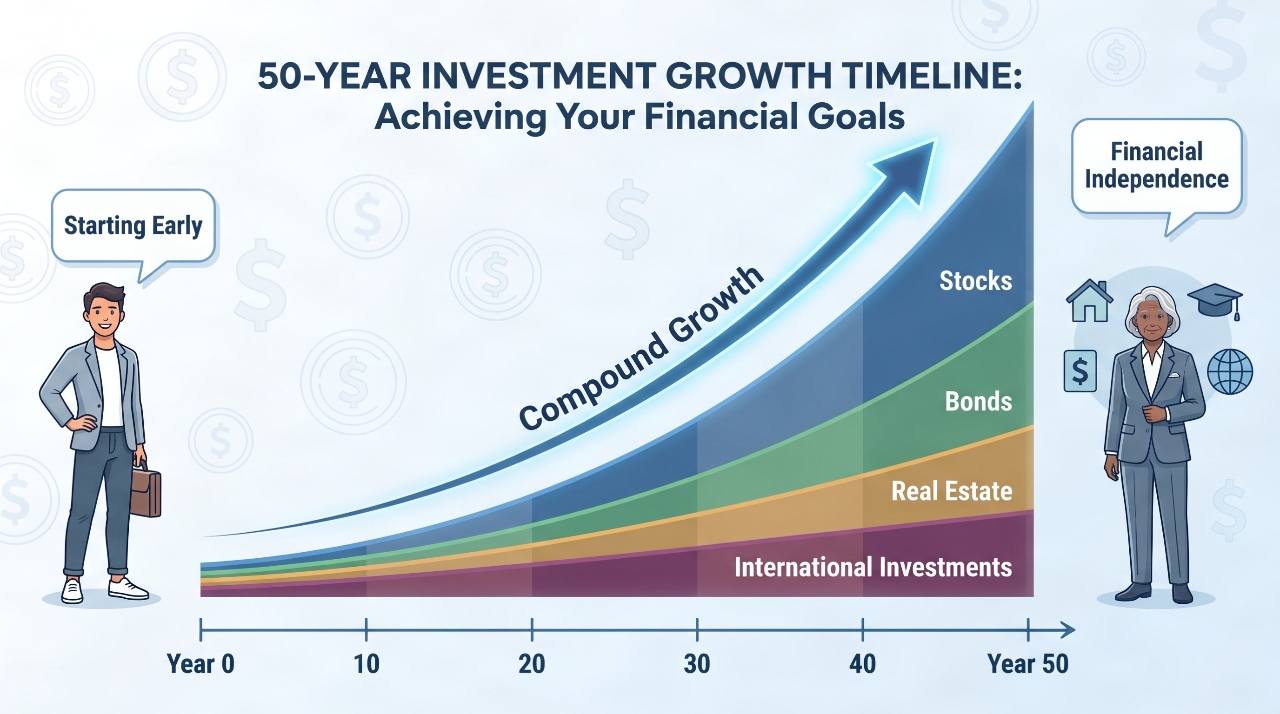
The reason is compound growth. Your money earns returns. Those returns then earn their own returns. This keeps happening year after year. Over 50 years, this effect becomes enormous. You’re not just earning money on your original investment. You’re earning money on all the previous earnings too.
Starting early doesn’t mean you need to invest huge amounts of money. It means you need to start the process. Even $100 per month at age 20 beats $1,000 per month at age 40. The extra 20 years of growth matters more than the extra money you’re putting in.
Understanding Compound Interest
Albert Einstein supposedly called compound interest the eighth wonder of the world. Whether he actually said this doesn’t matter. The idea is absolutely true.
Compound interest means you earn returns on your returns. Let’s use a simple example. You invest $10,000 in something that grows 8% per year. Year one, you make $800. Your total is now $10,800. Year two, you earn 8% on the $10,800, which is $864. Your total is now $11,664. You earned more money in year two without adding any new money.
This effect gets stronger as time passes. After 10 years, your $10,000 becomes $21,589. After 20 years, it becomes $46,610. After 50 years, it becomes $469,016. You only put in $10,000, but you end up with nearly $500,000. The extra $459,016 came from compound interest alone.
This is why time is more valuable than money when you’re young. Waiting five years to start investing might seem like no big deal. But those five years of compound growth are worth tens of thousands of dollars by the time you reach age 70. You can’t get those five years back.
Creating Your Basic Investment Foundation
Before you pick specific investments, you need a basic plan. This plan should answer three questions: What are you investing for? When do you need the money? How much risk can you handle?
The answer to the first question is usually retirement. Some people also invest for a house down payment or their children’s education. Be honest about your goal. This helps you stay focused when markets get scary.
The second question is about time. If you need the money in 50 years, you can take much bigger risks than someone who needs money in 5 years. Long term investment strategy relies on having time to recover from bad years. If you have 50 years ahead, you’ll go through at least 15 bad market years. You’ll also go through many good years. The good years usually outweigh the bad years over 50 years.
The third question is about sleep at night. Some people get anxious when their investments drop 10%. Others don’t worry until they drop 30%. Neither answer is wrong. You just need to be honest with yourself. A long term investment strategy only works if you can stick with it even when markets fall.
Choosing the Right Investment Types
You don’t need to pick individual stocks. In fact, most people shouldn’t. Professional investors spend all day researching companies and most of them underperform simple index funds anyway.
Index funds are funds that hold many companies at once. One popular index fund holds the 500 largest US companies. Another holds the entire US stock market. Others focus on international stocks, bonds, or real estate. The benefits are huge: they cost very little to own, they’re diversified, and they’re easy to understand.
Exchange traded funds or ETFs work similarly to index funds. They hold many investments in one simple package. ETFs are often cheaper and more flexible. Many people use ETFs as their main investment vehicle.
Bonds deserve a place in your portfolio even with a 50 year timeline. Bonds are loans to companies or governments. They provide steady income and go up in value when stocks go down. This creates a cushion during bad market years. With 50 years ahead, you can handle stock drops, but bonds make them easier to tolerate.
Real estate investment trusts or REITs let you invest in buildings and properties without buying them yourself. They pay good income and provide diversification beyond stocks and bonds. Many people add a small amount of REITs to their portfolio.
Building a Diversified Portfolio
Diversification means spreading your money across different types of investments. This protects you when one area performs poorly. It also ensures you benefit from whichever area performs best.
A simple portfolio for a 50 year investment strategy might look like this:
| Asset Type | Allocation |
|---|---|
| US Stock Market | 70% |
| International Stocks | 15% |
| Bonds | 10% |
| Real Estate Trusts | 5% |
This gives you exposure to thousands of companies across multiple countries. You’re not betting on any single company or country succeeding. You’re betting on the overall growth of economies worldwide. Over 50 years, this bet has always won.
As you age, you’ll adjust this mix. Someone with 50 years ahead can handle 80% stocks. Someone with 20 years ahead might use 60% stocks. Someone with 5 years ahead might use 40% stocks. The general rule is to become more conservative as you get closer to retirement.
You don’t need to own individual stocks, bonds, and real estate. You can use target date funds. These automatically adjust your portfolio mix based on your retirement date. You pick the fund matching your retirement year and it does the rest. This is perfect for people who don’t want to think about their portfolio constantly.
Staying Consistent Through Market Changes
The market will crash. This is guaranteed. Markets have crashed roughly every 3 to 5 years throughout history. Most crashes recover within a year or two. Some take longer. But every crash has eventually recovered. Anyone who stayed invested through every crash in the last 100 years became wealthy.
The biggest danger during crashes is panic selling. Markets drop 20%. You get scared. You sell everything. Markets recover but you’re sitting in cash missing the gains. This has destroyed more wealth than any other mistake.
During crashes, you should actually feel excited. Investments are on sale. Your regular monthly investment now buys more shares. You’re buying low. Everyone who stayed the course during the 2008 crash made huge gains by 2012. Those who sold lost money.
Keep a bigger emergency fund if crashes worry you. Save 6 to 12 months of living expenses in a savings account. This money stays separate from your investment account. If you need money during a crash, you use the emergency fund. Your investments stay invested and can recover.
Don’t check your portfolio too often. People who check quarterly or yearly are happier than people who check daily. Seeing daily changes makes you emotional. Seeing yearly results lets you focus on the long term. Set up automatic monthly investments and then ignore your account. Come back to it once per year for your annual review.
Avoiding Common Investment Mistakes
Mistake number one is trying to time the market. People sell before crashes and buy before rallies. This sounds smart but nobody actually does it successfully. By the time you realize a crash is coming, it’s usually already started. By the time you realize the bottom is reached, the recovery is underway. Just invest regularly and ignore timing.
Mistake number two is paying too much in fees. Some investment advisors charge 1% or more per year. Over 50 years, high fees destroy your wealth. On a $100,000 portfolio, a 1% fee costs you tens of thousands of dollars in lost growth. Use low cost index funds and ETFs. They typically cost 0.03% to 0.20% per year. The difference is enormous.
Mistake number three is trading too much. Every time you trade, you pay fees and taxes. You also usually buy high and sell low because of emotions. Your natural instinct to trade will hurt your results. Resist it. Buy good investments and hold them for decades.
Mistake number four is chasing performance. You read that some investment returned 50% last year. You switch to it. But good investments that returned 50% last year usually underperform the next year. You end up buying high and selling low. Stick with your diversified portfolio regardless of what’s hot this year.
Mistake number five is not starting because you think you need perfect knowledge. You don’t need to be an expert. You just need to start with a simple portfolio and add money regularly. Anyone with basic math skills can execute a long term investment strategy successfully.
Adjusting Your Plan as You Age
A 50 year investment strategy isn’t actually static for 50 years. You’ll make changes as circumstances change and as you age.
In your 20s and 30s, go aggressive. You can handle stock market drops because you have decades to recover. Use 80% to 90% stocks. Bad years hurt less when good years can multiply your money.
In your 40s and 50s, gradually reduce stock exposure. Use 60% to 70% stocks. You still have decades ahead but you’re closer to using this money. Bonds provide more protection.
In your 60s approaching retirement, use 40% to 50% stocks. You need your money to last decades but you also need protection from crashes right before retirement.
Review your portfolio once per year. Check that your allocation still matches your goals and age. If stocks have grown to 85% of your portfolio due to gains, sell some stocks to buy bonds. This is called rebalancing. It forces you to sell high and buy low. It keeps your portfolio from becoming too risky.
You should also increase your investment amount when you can. A raise at work? Invest the increase. A bonus? Invest it. Money from a side project? Invest it. This is how people who start with nothing become wealthy.
Real Results from Long Term Investing
Let’s look at real historical numbers. The US stock market returned approximately 10% per year on average over the last 100 years. This includes all crashes, wars, and recessions.
Someone who invested $5,000 per year in a stock index starting in 1980 would have about $8.7 million by 2024. That’s $220,000 of their own money becoming $8.7 million. The extra $8.48 million came from compound growth.
Someone who invested $10,000 per year starting in 1990 would have about $7.2 million by 2024. That’s $340,000 of their own money becoming $7.2 million. Time creates these results.
Real people have done this. Teachers with pensions who invested extra money became millionaires. Office workers who invested $500 per month became multimillionaires. People without exceptional skills or luck, just regular people who started a long term investment strategy and stuck with it.
Getting Started Today
You don’t need to be an expert to start. You need three things: a brokerage account, a plan, and monthly deposits.
Open a brokerage account. If you work, ask if your employer offers a 401(k) or 403(b). This is the easiest place to start. Contributions come straight from your paycheck. Tax benefits make this even better. If your employer doesn’t offer this, open an IRA at a major brokerage firm. If you have extra money beyond the IRA limit, open a regular brokerage account.
Choose your investments. If this feels overwhelming, pick a target date fund matching your retirement year. If you want more control, use the simple portfolio I described earlier: 70% US stocks, 15% international stocks, 10% bonds, 5% real estate. You can implement this with just four index funds or ETFs.
Set up automatic monthly deposits. This is critical. You want money automatically invested before you have a chance to spend it. Most people can save $200 to $500 per month if they prioritize it. Start with what you can afford. You can increase it later.
Then ignore it. Don’t check constantly. Don’t second guess your choices. Let compound growth do its job for the next 50 years.
Conclusion:
A 50 year investment strategy isn’t complicated. It’s not about picking winners or timing the market. It’s about starting, staying consistent, and letting time create wealth. Most people who follow this simple approach become millionaires. Some become multimillionaires. It’s almost impossible not to succeed if you stay the course.
The obstacles you’ll face are internal. You’ll feel scared during crashes. You’ll feel tempted to trade. You’ll see others getting rich quick and feel like you’re moving too slowly. These feelings are normal. Every successful investor has felt them. The ones who succeeded didn’t give in to the feelings. They stuck with their plan.
Begin now. Start small if necessary. Increase your investment as you earn more. Rebalance annually. Ignore the noise. In 50 years, you’ll be grateful you started today. Your money will work for you. You’ll own part of thousands of companies across the world. Compound growth will have done most of the work. You’ll have achieved what most people only dream about: real financial security.