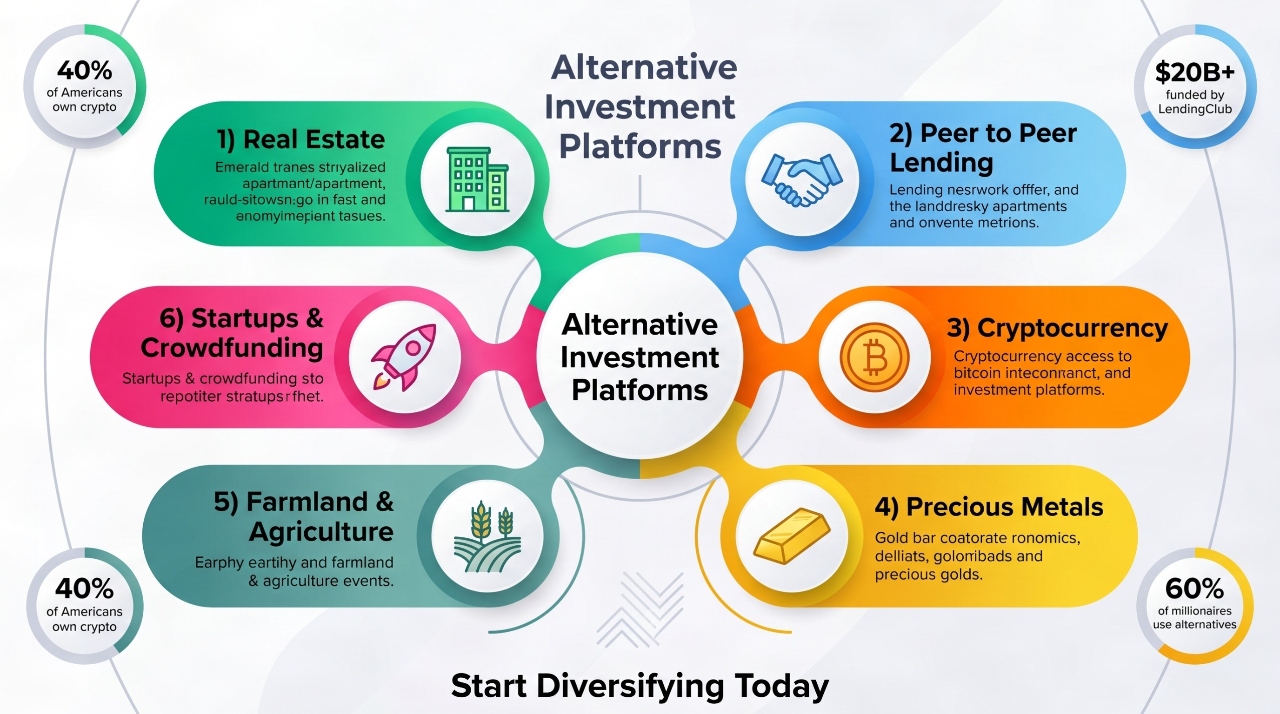
Most people invest in stocks and bonds because that’s what they know. But here’s the thing: about 60% of millionaires say they have money in alternative investments beyond the traditional stock market. This means real estate, peer to peer lending, cryptocurrencies, and other options that don’t move exactly like the stock market. These platforms are easier to use than ever before, and you don’t need a lot of money to start.
The problem is finding the right platform. There are hundreds of alternatives out there, and picking the wrong one can cost you money or waste your time. That’s why we created this guide. We’ll show you the best alternative investment platforms available today, how they work, and which ones might fit your goals.
WHY ALTERNATIVE INVESTMENTS MATTER
When your entire portfolio sits in the stock market, you’re dependent on one thing. If stocks drop 30%, your entire nest egg drops 30%. Alternative investments don’t always move with the stock market, which means they can protect your money when stocks struggle.
Real estate tends to hold value during stock market crashes. Peer to peer lending generates steady income regardless of stock prices. Cryptocurrencies move on their own factors. When you spread your money across different types of investments, you create a stronger financial position.
Adding alternative investments also opens new ways to earn money. You can earn rental income from real estate platforms. You can collect interest from lending platforms. You can earn dividends from commodities. These different income streams reduce your risk and increase your potential returns.
REAL ESTATE INVESTMENT PLATFORMS
Real estate has created more millionaires than any other investment type. The problem is that buying physical property requires a lot of money upfront and involves complicated paperwork. Real estate investment platforms solved this problem by letting you own pieces of properties with just a few hundred dollars.
How Real Estate Platforms Work
These platforms find real estate projects that need funding. They break the property into small pieces and sell those pieces to investors like you. As the property makes money through rent or eventual sale, you get a share of the profits. You don’t deal with tenants, maintenance, or management. The platform handles all of that.
Real estate platforms typically look for three types of properties: apartment buildings, commercial spaces, and single family homes. Some focus on developing new properties, while others buy existing buildings that already generate rental income.
Top Real Estate Platforms
Fundrise lets you start with just $10. They offer both debt investments (you’re basically lending money) and equity investments (you own a piece). The platform focuses on real estate development projects and rental properties. Most investors see returns between 4% and 8% per year. Money gets locked up for set periods, usually three to five years, but they offer a secondary market where you can sell your position early if needed.
RealtyMogul requires a $500 minimum investment. They specialize in commercial real estate like shopping centers and office buildings. The platform has completed over $1 billion in real estate deals. Your returns typically range from 5% to 12% annually, though higher returns come with higher risk. Projects have specific timelines, so you know when your money will return.
CrowdStreet focuses on commercial real estate for more experienced investors. The minimum investment is $25,000 for most deals, but they occasionally offer smaller options. Returns average 6% to 15% depending on the deal. They’re transparent about each project and provide detailed information before you invest.
Arrived specializes in single family home rentals. You can start with $100 and own fractional shares of residential properties. The platform handles tenant management and property maintenance. Annual returns average 5% to 8% from rental income plus potential appreciation.
PEER TO PEER LENDING PLATFORMS
Peer to peer lending lets you become a bank. People and small businesses borrow money, and you lend it to them. They pay you interest every month. It’s that simple. You’re making money while helping someone achieve their goals.
How Peer to Peer Lending Works
When someone applies to borrow, the platform checks their credit and income. They assign them a risk level based on their financial health. Riskier borrowers pay higher interest rates. You choose which borrowers you want to fund. You can lend $25 to one person or spread your money across many borrowers to reduce risk.
Your money gets paid back gradually. If a borrower makes monthly payments of $200, you’ll receive your portion of that payment. Over time, you recover your investment plus interest. Most platforms let you reinvest payments into new loans automatically.
Best Peer to Peer Lending Sites
LendingClub is the largest peer to peer lending platform in America. They have funded over $20 billion in loans. You can start investing with $1,000. Personal loans on their platform have interest rates from 5% to 36%, so you choose your risk level. The platform reports average returns between 4% and 7% annually, but past returns don’t guarantee future results.
Prosper focuses on personal loans and requires a $1,000 minimum investment. They’ve funded over $16 billion in loans. Returns average 5% to 7% per year. You can diversify your money across hundreds of loans to lower risk. The platform handles all collection efforts, so if someone defaults, they chase the payment for you.
LendingTree isn’t a lending platform itself, but rather a marketplace where you compare different lending platforms. Use it to find the best rates and terms before choosing where to invest.
The biggest risk with peer to peer lending is default. Sometimes borrowers can’t pay. That’s why spreading your money across many borrowers matters. If you lend $1,000 across 100 borrowers at $10 each, one default doesn’t hurt much.
CRYPTOCURRENCY INVESTMENT PLATFORMS
Cryptocurrency has become mainstream. More than 40% of Americans have heard of Bitcoin, and many now own crypto. The volatility scared people away for years, but modern platforms make cryptocurrency investing simpler and less risky.
Understanding Cryptocurrency Basics
Cryptocurrency is digital money that lives on the internet. Bitcoin is the oldest and most famous one. Thousands of other cryptocurrencies exist, each with different purposes. Some cryptocurrencies aim to be better money, while others enable smart contracts or other functions.
Unlike stocks, cryptocurrencies don’t represent company ownership. You own the currency itself. Your profits come from price appreciation when the asset becomes more valuable. Some cryptocurrencies also pay interest or dividends, creating passive income.
Popular Cryptocurrency Platforms
Coinbase is the easiest way to start buying cryptocurrency. The app is simple and includes security features that protect your coins. They offer Bitcoin, Ethereum, and over 200 other cryptocurrencies. Fees are slightly higher than competitors, but they’re worth it for beginners. You can set up automatic weekly or monthly purchases so you don’t have to think about timing.
Kraken works well for people ready to graduate beyond simple buying. The platform offers advanced trading features but remains simple enough for beginners. Fees are lower than Coinbase, and they support many currencies. Security features are excellent, with offline storage options for serious investors.
Gemini emphasizes security and regulation. They’re licensed by the New York Department of Financial Services, which means stronger consumer protections. Fees are competitive, and the platform offers staking opportunities where you earn cryptocurrency rewards.
Blockchain.com (formerly Blockchain Wallet) lets you buy, store, and trade cryptocurrency. They charge lower fees than most competitors and include built in privacy features. The platform works well for long term holders who won’t be trading frequently.
One strategy that works well for new cryptocurrency investors is dollar cost averaging. You invest the same amount every week or month regardless of price. This removes emotion from the decision and helps you avoid buying at peaks or selling at bottoms.
COMMODITIES AND PRECIOUS METALS PLATFORMS
Gold, silver, oil, and wheat are commodities. Investors have bought them for centuries because they hold value when other investments struggle. Modern platforms make owning commodities easier than storing physical gold or oil in your garage.
Physical Metals Platforms
Goldco specializes in precious metals IRAs. They help you move money from traditional retirement accounts into gold and silver without tax penalties. This is powerful because it moves gold into a tax protected retirement account. You get physical gold stored in secure vaults but enjoy the tax advantages of an IRA.
Kitco sells physical gold and silver at competitive prices. You receive the actual metal at your home or in their vault. They’ve operated since 1977 and have strong customer reviews. Buy when prices are low, store safely, and sell when prices rise.
Provident Metals focuses on low premiums. The markup over spot price is smaller than competitors, so you keep more money. They offer fast shipping and multiple storage options.
Physical metals work best as long term holdings. You’re not trying to profit from price swings week to week. Instead, you’re preserving wealth and protecting against inflation or currency problems.
Commodity ETFs
ETFs (Exchange Traded Funds) that track commodities offer easier entry. You buy them like stocks through any brokerage account. GLD tracks gold prices, SLV tracks silver, and USO tracks oil. No need to store anything or worry about authentication. You simply own shares that represent ownership in the commodity.
The advantage of ETFs is liquidity. You can sell instantly during market hours. Physical metals take longer to sell and involve selling to dealers who demand a markup.
CROWDFUNDING INVESTMENT PLATFORMS
Crowdfunding platforms let you invest in small businesses and startups. You become a partial owner and benefit when the company succeeds. These ventures are riskier than established companies, but the potential returns are much higher.
Equity Crowdfunding Sites
Wefunder connects you with early stage startups. You can invest as little as $100 in companies you believe in. If the company becomes successful, your investment grows significantly. Many startups fail, so this is high risk. Only invest money you can afford to lose completely.
SeedInvest focuses on screened startups. They review thousands of applications and only allow the best ones on the platform. This doesn’t guarantee success, but it means better odds. Returns for successful investments often exceed 5x or 10x your money.
Forge lets you buy and sell shares of private companies on a secondary market. This creates liquidity for private investments, which normally lock up your money for years. You can actually sell your position if you need cash.
Startup investing works best when you diversify across many companies. Invest small amounts in 20 different startups rather than betting everything on one. Most will fail or break even, but a few winners will make up for the losers.
BOND AND DEBT PLATFORMS
Bonds are loans. You lend money, and the borrower pays you back with interest. Government bonds are safe but pay almost nothing. Corporate bonds pay more but carry default risk. Platforms now make it easy to own hundreds of bonds.
How Bond Platforms Work
LendingClub and Prosper mentioned earlier are technically debt platforms where you’re making loans. But specific bond platforms focus on more traditional bonds.
Treasury Direct is the government’s official platform for buying U.S. Treasury bonds. You buy directly from the government with no fees. The rates are low but guaranteed. Your money is backed by the full strength of the U.S. government.
Municipal Bond Platforms like muni help you buy state and local bonds. These often have tax advantages because interest is exempt from federal taxes and sometimes state taxes too. If you’re in a high tax bracket, municipal bonds can provide better after tax returns.
Bond investing sounds boring because it is. Bonds don’t make exciting stories. But that’s their strength. They provide steady predictable income with lower risk than stocks. A balanced portfolio includes bonds even if you’re young and aggressive.
FARMLAND AND AGRICULTURE PLATFORMS
Farmland is America’s fifth best performing asset class over the past 20 years. Yet most people have no way to invest in it. Agriculture platforms solved this problem.
Farmland Investment Options
Farmland LP buys farmland and rents it to farmers. You own a share of the property and receive rental income plus potential appreciation. Land grows more valuable as the population increases and demand for food rises. The minimum investment is typically $5,000 to $10,000.
Agriterra focuses on farmland in developing countries where growth is highest. Farmers there need capital to improve their operations. You provide that capital and share in the profits. The minimum is $500 per investment, though you should make multiple investments to diversify.
FarmTogether takes a different approach. They improve struggling farms and make them profitable again. You invest in the operation and share in the profits from increased yields or sale of the improved farm.
Farmland returns typically range from 4% to 8% annually from rental income, plus potential appreciation. The asset performs well during inflation because food prices rise. Land also appreciates as population grows and development pressure increases.
HOW TO CHOOSE THE RIGHT PLATFORM
You don’t need to choose just one platform. The best investors typically use three to five platforms. This diversifies your risk and lets each platform handle what it does best.
Questions to Ask Before Investing
What’s your minimum investment? Can you afford it? Start with platforms that match your budget. Don’t overstrain your finances trying to meet a $10,000 minimum.
How long is your money locked up? Some platforms let you access money anytime. Others lock it away for years. Match the lock up period to your financial situation. If you might need the money in two years, avoid platforms requiring five year commitments.
What are the fees? Compare all costs including account fees, transaction fees, and platform fees. Over time, small fee differences add up. A platform charging 2% annually will perform much worse than one charging 0.5%.
What’s your risk tolerance? Real estate and bonds are relatively safe. Startups and cryptocurrencies are risky. Peer to peer lending falls in between. Honest assessment of your risk tolerance prevents panic selling during downturns.
Does the platform offer diversification? Can you spread money across many investments or does it force you into large single positions? Diversification reduces risk significantly.
A Sample Diversified Approach
Start with real estate through Fundrise ($500 initial investment, 4% to 8% returns). Add peer to peer lending through LendingClub ($1,000, 4% to 7% returns). Include some cryptocurrency through Coinbase (as much as you want, highly volatile). Add precious metals through GLD ETF (as much as you want, stable value). Consider one or two startup investments through Wefunder (small amounts you can afford to lose).
This mix gives you real estate stability, lending income, growth potential from startups, inflation protection from metals, and upside from cryptocurrency. When stocks crash, this portfolio won’t crash equally because the investments don’t move together.
UNDERSTANDING RISK AND VOLATILITY
Higher returns always come with higher risk. Bonds might pay 3% safely. Startups might return 500% or lose everything. The trade off is unavoidable. Your job is choosing which risks make sense for you.
Volatility is short term price swings. Bitcoin can drop 20% in a week, then rise 30% the next week. This terrifies some investors. But if you’re holding for years, short term swings don’t matter. You care about the price when you need the money, not the price today.
Real estate and peer to peer lending have low volatility. Prices don’t swing wildly day to day. Cryptocurrency and startups have high volatility. Choose higher volatility investments only for money you won’t need for many years.
RED FLAGS AND COMMON MISTAKES
Some platforms are scams. Others charge excessive fees. Still others fail completely. Protecting yourself takes basic caution.
Watch out for guaranteed returns. Nothing in investing is guaranteed. Anyone promising 20% returns guaranteed is lying. Real investments have variability.
Avoid platforms with complicated fee structures. Simple is better. If you can’t easily understand how much fees will cost, find another platform.
Check the company’s history. How long have they operated? Do they have financial backing? Independent reviews? Established companies have less failure risk than new startups.
Never invest more than you can afford to lose in speculative alternatives like cryptocurrency or startups. These can go to zero. Build your safety net with bonds and stable real estate investments first.
Don’t panic sell during downturns. This is where people lose money. Markets always recover. Selling during crashes locks in losses. Hold through temporary declines.
TAX IMPLICATIONS
Different investment types trigger different taxes. Understanding this before you invest saves money.
Stock gains are capital gains taxed at your regular income tax rate or preferential long term capital gains rates. Real estate provides depreciation deductions that reduce taxable income. Peer to peer lending interest is taxed as regular income, which is the highest rate. Cryptocurrency is currently treated like property, triggering capital gains taxes on profits.
Placing aggressive investments into retirement accounts like IRAs or 401ks avoids immediate taxes. You can buy cryptocurrency, startups, or anything else inside an IRA without tax consequences. Just don’t exceed contribution limits.
Talk to a tax professional before investing large amounts. They can show you strategies to minimize taxes legally. The few hundred dollars spent on advice often saves thousands in taxes.
STARTING YOUR ALTERNATIVE INVESTMENT JOURNEY
You don’t need to be rich to start alternative investing. Most platforms accept investors with $500 to $1,000 initial deposits. You can begin exploring different platforms without risking huge amounts.
Pick one or two platforms this month. Open accounts, fund them with what you can afford, and make your first investments. Track how they perform. After three to six months, evaluate your results and decide if you want to add more platforms or increase investments.
Keep emotions out of decisions. Set an allocation like 60% real estate, 20% lending, 10% cryptocurrency, 10% startups. Stick to it. When one investment type outperforms and becomes 65% of your portfolio, rebalance back to 60%. This forces you to sell winners and buy losers, which actually improves long term returns.
Document everything. Keep track of deposits, withdrawals, and performance. This helps with taxes and shows you what’s actually working. A simple spreadsheet tracking each platform’s balance monthly is enough.
CONCLUSION
Alternative investment platforms have democratized wealth building. What once required being rich or connected is now accessible to regular people. You can own real estate without landlord duties, lend money without being a bank, and invest in startups without knowing billionaires.
The key is starting small and thinking long term. Your first year might feel boring as you watch 4% to 6% returns pile up. But compound returns accelerate over time. $5,000 growing at 6% annually becomes $25,000 in 27 years. Add more money regularly and the growth accelerates faster.
Begin by choosing one platform that aligns with your goals and comfort level. Open an account. Make your first investment. Experience how it works. Then gradually add other platforms as you gain confidence. In five years, your diversified portfolio will likely be producing thousands of dollars annually from multiple sources.
Your next step is simple: choose one platform from this article and sign up this week. Start small. You can always increase investments later. The people who build wealth aren’t smarter than you. They simply started earlier and stayed consistent. Today is the perfect day to begin.