
Over 10 billion shares trade hands every single day on US stock exchanges, but missing the market open by just 30 minutes can mean the difference between catching a major price move and watching from the sidelines.
Knowing when the stock market opens matters more than you think. New investors lose money every year because they don’t understand trading hours. They place orders at the wrong time or expect trades to execute when the market is closed. Some miss important price movements because they confused time zones or forgot about a holiday.
This guide will show you exactly when the US stock market opens and closes. You’ll learn about different trading sessions, how time zones affect your trading, and which days the market stays closed. Whether you’re a brand new investor or someone who wants to sharpen their timing, you’ll find practical information you can use right away.
The simple answer is this: regular stock market hours run from 9:30 AM to 4:00 PM Eastern Time. But there’s much more you need to know to trade successfully.
The Basic Answer: US Stock Market Opening and Closing Times
The US stock market opens at 9:30 AM Eastern Time and closes at 4:00 PM Eastern Time. This schedule applies to both the New York Stock Exchange and NASDAQ, the two largest stock exchanges in America. That gives you 6.5 hours of regular trading each business day.
Markets operate Monday through Friday, excluding official holidays. No matter where you live in the United States or around the world, you need to convert your local time to Eastern Time to know when trading starts. A trader in California sees the market open at 6:30 AM, while someone in London watches it start at 2:30 PM their time.
These hours have been standard since 1985 when the NYSE moved its opening time from 10:00 AM to 9:30 AM. The change happened to create more overlap with European markets and give American traders a longer day. Before that, markets operated on different schedules that made international trading more difficult.
Why the Stock Market Opens at 9:30 AM
The 9:30 AM opening time serves several important purposes. When exchanges moved from the traditional 10:00 AM start, they wanted to capture more trading activity with Europe. London markets are already several hours into their trading day when New York opens, so the earlier start created better coordination between the two financial centers.
Time zones across America also played a role in choosing 9:30 AM. East Coast traders can get to their offices and prepare for the day. West Coast traders face a 6:30 AM opening, which is early but still manageable for professional investors. Any earlier would make it too difficult for people on Pacific Time to participate.
Market makers and specialists need time before the opening bell to review overnight news and orders. Between 4:00 AM and 9:30 AM, they process information from Asian and European markets, read earnings reports, and prepare for the trading day. The 9:30 AM start gives everyone enough time to digest news without making West Coast traders wake up in the middle of the night.
Different Trading Sessions You Should Know About
Stock trading doesn’t just happen during regular hours. Modern electronic trading created additional sessions that extend the trading day to nearly 16 hours.
Premarket Trading Session
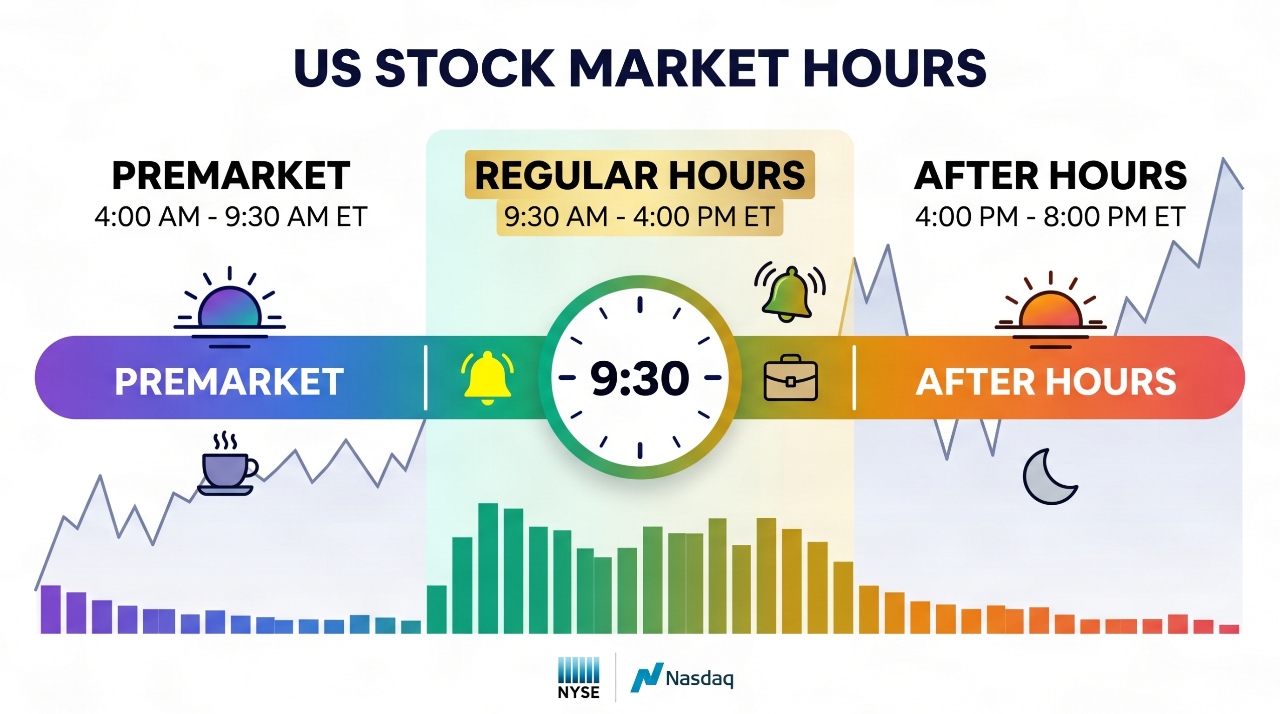
Premarket trading can start as early as 4:00 AM Eastern Time, though most brokers offer access beginning at 7:00 AM or 8:00 AM. This session lets investors react to overnight news before the regular market opens. You’ll see lower volume and wider spreads between bid and ask prices during these hours.
Professional traders and institutional investors dominate premarket trading. Individual investors can participate if their broker offers the service, but the risks increase. Prices can swing wildly on low volume, and you might not get the price you expect.
Regular Trading Session
The main trading session from 9:30 AM to 4:00 PM offers the highest volume and best liquidity. This is when most individual investors should focus their trading activity. Prices tend to be more stable, and you can enter and exit positions more easily. The vast majority of daily trading volume happens during these core hours.
After Hours Trading
After hours trading runs from 4:00 PM to 8:00 PM Eastern Time. Companies often release earnings reports after the market closes, which can cause significant price movements in this session. The same risks from premarket trading apply here: lower volume, wider spreads, and more price volatility.
Here’s a quick overview of all three sessions:
Trading Session Times and Characteristics:
- Premarket: 4:00 AM to 9:30 AM ET (most brokers 7:00 AM to 9:30 AM) – Low volume, high volatility, limited participation
- Regular Hours: 9:30 AM to 4:00 PM ET – High volume, best liquidity, most stable prices
- After Hours: 4:00 PM to 8:00 PM ET – Low volume, earnings reactions, wider spreads
What Happens at the Market Open
The opening bell at the New York Stock Exchange is more than just ceremony. At exactly 9:30 AM, a complex process begins to match buy and sell orders that accumulated overnight.
Market makers review all the orders placed when the market was closed and determine opening prices. This creates the first trades of the day, which can differ significantly from the previous day’s closing prices. Those differences are called gaps, and they happen when news or events change investor sentiment overnight.
The first 30 minutes of trading are typically the most volatile of the entire day. Volume surges as traders rush to execute their strategies. Prices can move quickly in either direction as buyers and sellers find equilibrium. Many experienced traders actually wait 15 to 30 minutes after the open before making their moves because prices tend to stabilize after the initial frenzy.
News releases often get timed for the market open. Economic data from the government frequently drops at 8:30 AM or 10:00 AM, creating additional volatility around the opening period. Corporate announcements also cluster around market hours to maximize their impact.
How Time Zones Affect Your Trading
Eastern Time serves as the official clock for all US stock market activity. You need to convert this to your local time zone to know when you can trade.
West Coast traders face the earliest start, with markets opening at 6:30 AM Pacific Time. That means waking up early or setting automated orders the night before. Central Time traders see a 8:30 AM open, while Mountain Time gets 7:30 AM. International traders face even bigger challenges, with Asian investors often trading in the middle of their night.
Daylight Saving Time adds another complication twice per year. When clocks “spring forward” in March and “fall back” in November, make sure your schedule adjusts properly. Most trading platforms and apps automatically convert times to your location, but you should verify this to avoid costly mistakes.
Setting alerts and reminders helps you catch the market open regardless of your time zone. Your smartphone can notify you 15 minutes before trading starts, giving you time to review news and prepare your trades.
Stock Market Holidays and Early Closures
The US stock market closes for nine federal holidays each year. You cannot trade stocks on these days:
- New Year’s Day
- Martin Luther King Jr. Day
- Presidents Day
- Good Friday
- Memorial Day
- Independence Day
- Labor Day
- Thanksgiving Day
- Christmas Day
When a holiday falls on a weekend, the market typically closes on the Friday before or Monday after. The exchanges publish their holiday schedules months in advance so traders can plan accordingly.
Early closures also happen on certain days. The market closes at 1:00 PM Eastern Time on the day before Independence Day if it falls on a weekday, the Friday after Thanksgiving, and Christmas Eve when it falls on a weekday. These early close days can catch unprepared traders off guard.
Bond markets sometimes follow a different holiday schedule than stock markets. Futures markets have their own calendars too. Always verify the schedule for the specific market you’re trading.
Three-day holiday weekends often see lighter trading volume on the Friday before or Tuesday after the break. Professional traders take vacations, and many investors avoid opening new positions before an extended closure.
Different Exchanges and Their Hours
The New York Stock Exchange and NASDAQ follow identical hours for stock trading. Both open at 9:30 AM and close at 4:00 PM Eastern Time Monday through Friday. This standardization makes life easier for traders who don’t need to track different schedules for different stocks.
The Chicago Board Options Exchange matches the stock market schedule since options derive their value from underlying stocks. Options trading runs from 9:30 AM to 4:00 PM on the same days as stocks.
Bond markets operate on a slightly different schedule, opening at 8:00 AM and closing at 5:00 PM Eastern Time. Government bonds and corporate bonds trade during these extended hours.
Futures markets run nearly 24 hours a day from Sunday evening through Friday afternoon. Stock index futures like the S&P 500 futures trade almost continuously, with only short breaks for maintenance. This gives traders a window into how the stock market might open based on overnight futures activity.
Cryptocurrency markets never close. Digital currencies trade 24 hours a day, seven days a week, including holidays. This creates a completely different trading environment compared to traditional stocks.
Best Times to Trade During the Day
Not all hours of the trading day offer equal opportunity. Volume and volatility change throughout the session, creating better and worse times to execute trades.
The first hour from 9:30 AM to 10:30 AM sees the highest volume and most dramatic price moves. Day traders love this period because stocks can move several percentage points in minutes. However, the volatility also increases risk for less experienced traders. Spreads can widen, and emotional trading often leads to mistakes.
Mid-day from roughly 12:00 PM to 2:00 PM typically slows down. Traders take lunch breaks, volume decreases, and prices tend to move in tighter ranges. This quiet period offers fewer opportunities for day traders but can be perfect for placing limit orders at specific prices.
The final hour from 3:00 PM to 4:00 PM picks up volume again in what traders call the “power hour.” Institutional investors often make their moves before the close, and day traders exit positions they don’t want to hold overnight. This creates another window of opportunity and volatility similar to the morning.
Long-term investors care less about these patterns. If you’re buying stocks to hold for months or years, the exact minute you buy matters far less than the price you pay. Using limit orders during any part of the day works fine for buy and hold strategies.
Friday afternoons often see decreased activity as traders head into the weekend. Volume typically drops after 3:00 PM on Fridays, and price movements can be smaller unless major news breaks.
Common Mistakes About Market Hours
Many investors lose money because they misunderstand how market hours work. The most common mistake is confusing Eastern Time with local time. A California trader who thinks the market opens at 9:30 AM their time will miss the first three hours of trading.
Forgetting about market holidays costs investors too. Placing a market order on a Monday holiday means your trade won’t execute until Tuesday, potentially at a very different price. Always check the calendar before planning trades around three-day weekends.
Early close days catch people off guard every year. That 1:00 PM close the day after Thanksgiving surprises traders who expect normal hours. Your orders might not fill, or you could get stuck in a position you wanted to exit.
Premarket and after hours trading differ significantly from regular hours, but some investors don’t realize this. They see a stock price moving at 7:00 AM and don’t understand why they can’t get that price, or why their broker won’t let them trade at all. Extended hours require special permissions with most brokers.
Daylight Saving Time changes cause confusion twice per year. Remember that market hours stay constant in Eastern Time, so your local time relationship to market hours shifts when your clocks change.
Placing a market order when the market is closed creates another common problem. That order will execute at whatever price the market opens at the next trading day. A big gap overnight can mean you pay much more or receive much less than you expected.
How Market Hours Affect Different Types of Traders
Your trading style determines how much you need to care about the exact opening time.
Day traders must be active during market hours since they open and close positions within a single day. Most day traders focus on the first and last hours when volume and volatility peak. They often wake up before the market opens to review premarket activity and plan their trades. Extended hours trading can provide additional opportunities, though the added risks require more experience.
Swing traders hold positions for several days or weeks. They care less about the exact opening time and more about daily or weekly price patterns. Swing traders can place limit orders before the market opens and let them execute during the day. They still need to understand market hours to time their entries and exits properly.
Long-term investors have the most flexibility with market hours. If you’re buying quality companies to hold for years, getting your order filled at 10:00 AM versus 2:00 PM rarely matters. Long-term investors can place limit orders any time and wait patiently for their target prices. Understanding market hours still helps, but it’s less critical for execution success.
Working professionals face unique challenges since regular market hours overlap with typical work schedules. Many people can’t watch the market from 9:30 AM to 4:00 PM because they have jobs. Extended hours trading before or after work provides one solution. Using limit orders and automated alerts offers another way to trade without watching every minute.
Placing Orders When the Market is Closed
Your broker accepts orders 24 hours a day, seven days a week, even though the market isn’t open that long. Orders placed when the market is closed get queued and execute when trading resumes.
Market orders placed overnight will execute at whatever price the market opens at the next trading day. This creates gap risk because the opening price can differ significantly from the previous close. News breaks overnight, and prices adjust to reflect new information.
Limit orders give you more control when placing trades outside market hours. You specify the exact price you’re willing to pay or accept. The order only executes if the market reaches your price. This protects you from paying too much or selling too cheaply because of an overnight gap.
Good-til-cancelled orders stay active until you cancel them or they execute. Day orders automatically cancel if they don’t fill by the end of the trading day. Understanding these order types helps you manage positions when you can’t watch the market constantly.
Gap risk represents the biggest danger of market orders placed overnight. A company might announce bad news after the close, causing the stock to drop 10% or more when trading resumes. Your market order to buy will execute at that lower open, but you’ll immediately have a loss. Limit orders would simply not execute, protecting you from the bad price.
What to Do Before the Market Opens
Successful traders develop a routine before the 9:30 AM opening bell. Checking premarket movers shows which stocks are active and where big money is flowing. Financial news websites and your broker’s platform display the most active premarket stocks.
Reviewing overnight developments in Asian and European markets provides context for how US stocks might open. If Asian markets dropped sharply overnight, US stocks often follow. European market direction can predict the first hour of US trading since there’s significant overlap.
Reading earnings reports released before the open helps you avoid surprises. Companies often announce quarterly results before the market opens, and these reports can move stocks 5% to 20% or more. Knowing which companies report on a given day keeps you informed.
The economic calendar shows when government data releases happen. Reports on employment, inflation, or GDP often drop at 8:30 AM, creating volatility right before or at the market open. Checking this calendar helps you anticipate potential market moves.
Reviewing your watchlist and portfolio takes just a few minutes but provides valuable perspective. Look at which of your stocks have news or earnings. Check if any companies you’re watching hit price targets overnight.
Planning your trades for the day works better than reacting spontaneously at the open. Decide which stocks you want to buy or sell and at what prices. Write down your plan so emotions don’t override your strategy when the bell rings.
Avoid making rushed decisions right at 9:30 AM. The opening minutes are chaotic, and prices often swing wildly before settling into a trend. Having a plan and waiting for the right moment produces better results than rushing to trade in the first 60 seconds.
Special Circumstances and Exceptions
Stock markets occasionally close for reasons beyond scheduled holidays. Emergency closures happen rarely but can occur during severe weather, technical failures, or national crises.
The September 11, 2001 terrorist attacks closed markets for four trading days, the longest shutdown since the Great Depression. Hurricane Sandy in 2012 forced a two-day closure, the first weather-related shutdown in over 100 years. These examples show that extraordinary circumstances can interrupt trading.
Trading halts during the day pause individual stocks or the entire market temporarily. Circuit breakers kick in if the S&P 500 drops 7%, 13%, or 20% in a single day. These automatic pauses give investors time to process information and can prevent panic selling.
Individual stock trading halts occur when a company has major news pending or when unusual trading activity triggers automatic stops. A stock might halt for 5 minutes or several hours until the company releases information or regulators review the situation.
Exchanges announce emergency closures as quickly as possible through official channels and news media. Modern technology makes unplanned closures less common than in the past, but traders should stay aware that markets can close unexpectedly.
Making the Most of Market Hours
The US stock market opens at 9:30 AM Eastern Time and closes at 4:00 PM Eastern Time, Monday through Friday, excluding holidays. This simple fact forms the foundation of successful stock trading. Know your time zone conversion, mark your calendar with market holidays, and understand the difference between regular hours and extended trading sessions.
Most investors don’t need to trade at the exact market open to succeed. Long-term investors can place limit orders any time and wait for good prices. Even active traders benefit from letting the market settle for 15 to 30 minutes before jumping in.
Check your broker’s platform to see what extended hours they offer. Mark the next market holiday on your calendar so you’re not surprised when markets close. Create a pre-market routine that helps you make smart decisions instead of emotional ones.
Start tomorrow morning by checking market news 15 minutes before the 9:30 AM open. See how premarket trading looks and read any important overnight news. This simple habit will improve your market awareness and help you make better trading decisions. Success in the stock market comes from preparation and discipline, not from rushing to trade the second the bell rings.