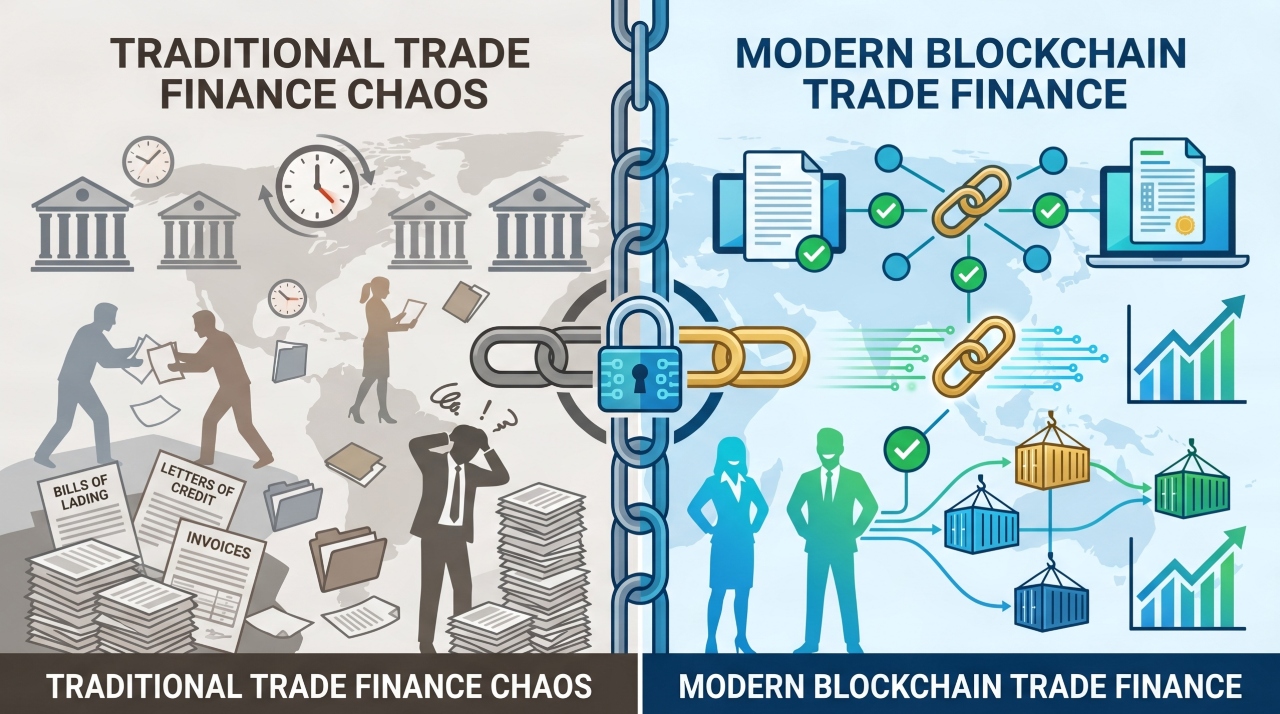
The average international trade transaction requires 36 original documents and 240 copies, passing through dozens of hands and taking weeks to complete. Blockchain can reduce this to hours with zero paper.
Trade finance has barely changed in 100 years despite being the backbone of global commerce. Companies still use physical bills of lading, paper letters of credit, and manual document verification. This system works but moves slowly and costs too much money.
You will learn exactly how blockchain solves real problems for international trade. This guide covers what it costs to implement, which companies are already seeing results, and whether this technology makes sense for your business. The focus is on practical applications and measurable benefits, not theoretical hype or technical jargon.
What Is Trade Finance and Why It Needs Fixing
Trade finance is the financial products and services that make international trade possible. When a company in the US buys goods from China, neither party wants to take full risk. The buyer does not want to pay before receiving goods. The seller does not want to ship without a payment guarantee.
Banks step in with letters of credit, guarantees, and financing. These instruments protect both parties but create massive paperwork and delays.
The current problems with traditional trade finance are significant. Paper based processes mean documents get lost, damaged, or forged. A single missing signature can stop a million dollar shipment. Multiple intermediaries each add costs and delays as banks, freight forwarders, customs agents, and insurers handle the same documents separately. The World Trade Organization tracks global trade finance trends and provides detailed statistics on how traditional processes impact international commerce and business growth.
Fraud costs billions annually through fake bills of lading, double financing of the same cargo, and counterfeit letters of credit. Limited access for small businesses exists because banks often reject trade finance requests from smaller companies since manual verification costs too much for smaller deals. High costs make some trades unprofitable when fees reach 10% to 15% of transaction value for complex deals.
Long processing times hurt cash flow because waiting 30 to 90 days for payment creates working capital problems. These challenges have persisted because the system works just well enough that nobody wanted to invest in change. Blockchain finally offers a compelling alternative that addresses every one of these issues.
How Blockchain Works for Trade Finance
A blockchain is a shared digital ledger that multiple parties can access but nobody controls alone. Information gets recorded in blocks that link together in a chain. Once recorded, data cannot be changed without everyone knowing.
For trade finance, this means all parties see the same information at the same time. The exporter, importer, banks, customs, freight companies, and insurers all access one source of truth. Everyone knows exactly what stage a transaction is in without making phone calls or sending emails.
Smart contracts automate agreements by executing automatically when conditions are met. If the shipping company confirms delivery, the smart contract releases payment instantly. No human needs to review documents and approve the transfer. These programs follow simple logic like “if delivery confirmed then release payment.”
Digital documents replace paper entirely. Bills of lading, certificates of origin, inspection reports, and insurance policies exist as digital files on the blockchain. They cannot be lost, stolen, or forged because copies exist simultaneously on thousands of computers.
Cryptographic security prevents tampering. Each transaction gets encrypted and verified by multiple network participants. Changing historical records would require controlling most of the network, which is practically impossible. This makes blockchain vastly more secure than paper stored in filing cabinets.
Most trade finance blockchains are private, meaning only approved participants can join. This addresses privacy concerns while maintaining the benefits of shared information. Your competitors cannot see your transactions, but all authorized parties in a specific deal can see everything relevant to that deal.
Real Benefits Companies Are Seeing Right Now
Speed improvements are dramatic and immediate. Transactions that took 5 to 10 days now complete in 24 hours or less. HSBC reduced letter of credit processing time from 5 to 10 days down to 24 hours using blockchain technology. Companies report that deals moving faster improve everything downstream.
Cost reductions reach 50% to 80% in real implementations. Eliminating manual document processing, reducing intermediaries, and preventing errors cut expenses significantly. The TradeLens platform claims to reduce shipping documentation costs by up to 80% for participating companies. When you handle 100,000 transactions annually, this savings becomes enormous.
Fraud prevention saves billions by making it nearly impossible to use the same collateral for multiple loans or create fake shipping documents. Every transaction gets verified by multiple parties instantly. A document cannot exist in two places simultaneously on blockchain, preventing the double financing scams that plague traditional trade finance.
Improved cash flow helps smaller businesses compete. Faster processing means exporters get paid quicker and importers receive goods sooner. Working capital that was tied up for weeks gets freed in days. For small companies operating on tight margins, this difference determines whether they can take certain deals.
Greater transparency builds trust between trading partners. All parties see the same information simultaneously. No more calling banks to check if documents arrived or payments were sent. Everyone knows the status in real time without waiting for email responses.
Better access for small companies levels the playing field. Automated verification costs the same regardless of transaction size. Banks can profitably serve smaller deals that were not worth the manual processing costs before. Small exporters finally get access to trade finance that was previously available only to large multinational corporations.
Reduced errors from manual data entry eliminate a massive source of problems. Information gets entered once and shared across the network. No more retyping the same details into different systems, which eliminates transcription mistakes. One entry point means one chance to get it right instead of ten.
Easier compliance and auditing become possible because complete transaction history exists permanently. Regulators can verify compliance without requesting documents. Companies can prove legitimate trade for customs and tax purposes with perfect documentation.
Barclays completed a letter of credit transaction in less than 4 hours versus the typical 7 to 10 days for an Irish dairy cooperative exporting cheese to Seychelles. Standard Chartered processed the first blockchain based letter of credit for a shipment from China to Bangladesh, reducing processing time by 80%. HSBC and ING executed a live trade finance transaction for a Cargill soybean shipment from Argentina to Malaysia. These are not theoretical benefits but proven results from major financial institutions.
Major Blockchain Trade Finance Platforms Operating Today
We.trade is a European platform backed by major banks including Deutsche Bank, HSBC, and Santander. It focuses on small and medium businesses in Europe and offers trade finance products like guarantees and letters of credit through a simple digital interface. The platform made these services accessible to companies that previously could not get bank attention for smaller deals.
Komgo specializes in commodity trade finance with Shell, BP, and major banks creating this platform for oil and gas transactions. It handles letters of credit, know your customer verification, and document management for energy trades. This focus on a specific industry allows deep customization for commodity trading needs.
Contour, formerly called Voltron, processes letters of credit using blockchain with HSBC, ING, and Standard Chartered as developers. Now operating commercially with over 50 corporate clients across multiple continents, it demonstrates that major banks trust this technology with real transactions.
TradeLens from Maersk and IBM focuses on shipping documentation and supply chain visibility. Over 150 organizations use the platform, which has processed over 1 billion shipping events. It digitizes bills of lading and other cargo documents, eliminating the paper that clogs international shipping.
Marco Polo Network provides working capital financing for international trade built on R3’s Corda blockchain. It offers receivables financing and payment commitments with faster approval and lower costs than traditional bank financing. This platform extends credit to companies in the supply chain, not just the primary trader.
HKTFP, the Hong Kong Trade Finance Platform backed by the Hong Kong Monetary Authority, connects banks and trade participants in Asia. Government support gives it credibility and adoption across the region, showing that countries view blockchain trade finance as important infrastructure.
These platforms often work together or integrate with each other. The industry recognizes that multiple competing networks create problems, so interoperability is a priority. Adoption varies by region, with Asia leading in blockchain trade finance implementation particularly in Singapore and Hong Kong. Europe follows with strong growth while United States adoption is slower but increasing.
Most platforms charge transaction fees lower than traditional trade finance costs. A letter of credit costing $1,000 through traditional banking might cost $300 to $500 on blockchain, demonstrating tangible savings from the start.
How Smart Contracts Automate Trade Finance
Smart contracts are agreements written in computer code that execute automatically when specific conditions are met. A letter of credit smart contract might say: “Release payment when shipping company confirms delivery at port AND inspection company confirms goods match specifications AND customs provides clearance documentation.” The system checks these conditions constantly and releases payment the moment all are satisfied.
Compare this to the traditional process where humans check documents, verify signatures, call counterparties, and manually approve payments. Each step takes time and creates error opportunities. Smart contracts eliminate the waiting and the mistakes.
Payment on delivery contracts release funds when goods arrive without any bank officer needing to review shipping documents. Escrow smart contracts hold payment until both parties confirm satisfaction, eliminating disputes about who should release funds. Insurance smart contracts pay claims automatically when triggering events occur, similar to flight delay insurance that pays instantly when airlines report delays.
Financing smart contracts provide working capital against shipments automatically. When goods ship, financing becomes available without loan applications. This speeds cash flow for exporters who need immediate funding while waiting for buyer payment.
Smart contracts only work well when conditions can be verified digitally. Subjective quality assessments still need human judgment. Complex disputes cannot be fully automated. Be realistic about what automation can achieve.
Most trade finance smart contracts run on private blockchains where only authorized parties can view and verify transactions. This protects confidential business information while maintaining automation benefits. Your supplier does not see your buyer’s identity, but the payment system still functions automatically.
Security and Privacy in Blockchain Trade Finance
Concerns about putting sensitive trade information on blockchain are understandable and solvable. Private blockchains address most privacy issues by requiring permission to join. Only verified participants like banks, companies, and service providers can access the network. Random people cannot see your transactions.
Encryption protects data even on the blockchain. Information gets scrambled so only authorized parties can read it. Even if someone accessed the blockchain, they would see meaningless encrypted data. Access controls determine what each participant can see, so your bank sees different information than the shipping company.
Blockchain data stays more secure than traditional systems in many ways. Paper documents get lost, stolen, or damaged easily. Email attachments can be intercepted. Blockchain data exists in multiple locations simultaneously, making it nearly impossible to destroy or lose. Hackers would need to attack thousands of computers simultaneously to change records.
Software bugs, weak passwords, and insider threats still exist even with blockchain. Companies must maintain good security practices alongside blockchain adoption. Blockchain does not eliminate all security risks but substantially reduces them compared to paper and email.
Blockchain creates permanent audit trails that prove compliance with trade regulations, sanctions screening, and anti money laundering requirements. This transparency actually helps companies demonstrate they follow rules. Regulators can verify compliance without requesting documents.
The myth that blockchain is anonymous and enables crime does not apply to trade finance. Private trade finance blockchains require full identity verification. Know your customer rules apply to all participants. The transparency actually makes illegal activity harder than traditional paper systems.
Data sovereignty and cross border data transfer regulations affect blockchain implementation. Companies must ensure their blockchain solutions comply with local data protection laws like GDPR in Europe. This requires careful platform selection and configuration.
Challenges Companies Face Adopting Blockchain Trade Finance
Integration with existing systems requires significant technical work. Banks and companies run on legacy software not designed to connect with blockchain. Building bridges between old and new systems costs money and time. A company with 30 year old banking software faces bigger integration challenges than one using modern systems.
Standardization problems create compatibility issues. Different blockchain platforms use different technologies and standards. A transaction starting on one platform may not transfer to another easily. Industry groups are working on solutions, but full interoperability remains years away.
Network effects delay adoption because blockchain trade finance works best when all parties use the same platform. If your bank uses one blockchain but your buyer’s bank uses another, you cannot transact. Getting everyone on the same network takes time and coordination.
Regulatory uncertainty makes companies cautious. Rules about digital signatures, smart contracts, and blockchain evidence in disputes remain unclear in many countries. Companies worry about investing in technology that regulators might restrict later. Different countries approve blockchain at different speeds, creating international complications.
Cost of implementation deters smaller organizations. While blockchain reduces ongoing costs, initial investment in technology, training, and integration can be substantial. Small banks and mid size companies struggle to justify the upfront expense even when long term savings are clear.
Resistance to change from people comfortable with current systems slows adoption. Trade finance professionals have used paper documents for decades. Convincing them to trust digital processes requires training and cultural change. Some older workers retire rather than learn new technology.
Skills shortage limits implementation speed. Blockchain developers with trade finance knowledge are rare and expensive. Companies struggle to find people who understand both technologies. Wages for these specialists keep rising faster than for other IT roles.
Scalability questions remain for very high transaction volumes. Some blockchain platforms slow down when processing thousands of transactions simultaneously. Testing continues on whether current technology can handle global trade finance volume at peak times. These obstacles are decreasing as the industry matures and governments provide supportive frameworks.
What Small and Medium Businesses Need to Know
Blockchain trade finance is not just for giant corporations. Small businesses actually benefit more in some ways because automation reduces per transaction costs. Access to financing improves because automated verification reduces bank costs. Banks that would not bother with small trade finance deals now find them profitable through blockchain platforms.
Lower transaction costs make smaller international trades economical. Traditional trade finance fees make $10,000 shipments unprofitable. Blockchain reduces fees enough to make small trades viable. Faster processing helps small businesses compete by improving cash flow.
Ask your bank if they offer blockchain trade finance options. Many major banks have programs but do not advertise them widely. Check if your trading partners use blockchain platforms because if your biggest customer or supplier uses a particular system, learning that system makes sense.
Join industry associations that provide blockchain education and access. Trade groups often negotiate group access to platforms at reduced costs. Start with pilot transactions to learn the technology without committing your entire business at once. Test with one or two deals to understand how it works.
You do not need technical expertise to use blockchain trade finance. Modern platforms have simple interfaces similar to online banking. You do not program smart contracts yourself any more than you write your own accounting software. Be patient because adoption takes time, as your entire supply chain may not switch overnight.
Hybrid approaches using both traditional and blockchain methods will exist for years. Consider the competitive advantage of early adoption because companies that master blockchain trade finance now will be better positioned as it becomes standard practice.
Costs of Implementing Blockchain Trade Finance
Platform fees vary by provider and transaction volume. Some charge monthly subscriptions around $500 to $5,000. Others use per transaction pricing of $50 to $500 depending on complexity. Transaction fees typically run lower than traditional trade finance costs.
A letter of credit costing $1,000 through traditional banking might cost $300 to $500 on blockchain. Integration costs depend on your current systems. Simple connections to modern banking software might cost $10,000 to $50,000. Complex integrations with legacy systems can reach $100,000 to $500,000.
Training expenses include employee time learning new systems and potentially hiring consultants. Budget $5,000 to $25,000 for basic training programs. Software updates, technical support, and platform subscriptions create recurring expenses similar to other business software.
Companies processing significant trade finance volume often recover implementation costs within one to two years through reduced fees and faster processing. Some platforms offer free trials or pilot programs. Testing before committing helps companies understand real costs and benefits for their specific situation.
Payment models differ across platforms. Some charge buyers, others charge sellers, some split costs. Understanding who pays what matters for budgeting and profitability analysis. Costs continue decreasing as technology matures and competition increases. Early adopters paid premium prices, but current costs are much more reasonable for new entrants.
Regulatory Environment for Blockchain Trade Finance
Singapore leads with clear regulations supporting blockchain trade finance. The Monetary Authority of Singapore actively promotes digital trade platforms and has created regulatory sandboxes for testing. This forward thinking approach attracts blockchain companies to the region.
The United Kingdom provides regulatory clarity through Financial Conduct Authority guidance. UK law recognizes digital signatures and smart contracts as legally binding in most circumstances. The European Union created frameworks under eIDAS regulation that give digital documents legal status equal to paper. This removes major barriers to blockchain adoption across Europe.
The United States has fragmented regulation with different states taking different approaches. Federal agencies like the OCC encourage innovation but have not created comprehensive blockchain trade finance rules. China promotes blockchain for trade finance while restricting cryptocurrency. Government backed platforms operate alongside private initiatives. Hong Kong established the HKTFP with government support, signaling regulatory acceptance and encouragement.
Key regulatory questions still being resolved include the legal status of smart contracts in disputes. Can courts enforce automatically executed agreements? Most jurisdictions say yes, but details vary. Digital document acceptance by customs and regulators is improving, with most major trading nations now accepting electronic bills of lading and other documents. Universal acceptance is not yet complete.
Cross border data transfer rules affect how transaction data moves internationally on blockchains. GDPR in Europe and similar laws elsewhere create compliance requirements. Anti money laundering compliance on blockchain platforms requires the same customer verification and transaction monitoring as traditional systems.
Generally, regulatory environments support blockchain trade finance because it improves transparency and reduces fraud. Regulators prefer visible, traceable transactions over paper documents that can be forged. Companies should consult legal experts familiar with both trade finance and blockchain before implementing systems.
Comparing Blockchain Platforms: What to Look For
Geographic coverage matters because platforms work best when your trading partners participate. Choose platforms strong in your key markets. Bank participation determines financing options, as platforms backed by major banks offer better access to credit and guarantees.
Functionality offered varies widely across platforms. Some handle only letters of credit. Others provide full trade finance suites including insurance, financing, and documentation. Integration capabilities with your current systems affect implementation difficulty. Platforms with APIs that connect easily to common ERP and banking systems cost less to deploy.
Transaction costs differ between platforms, so compare total costs including subscription fees, transaction charges, and integration expenses. User interface simplicity impacts employee adoption because complicated platforms require more training and create more errors. Customer support quality becomes critical when problems occur. Platforms with responsive support teams prevent costly delays.
Track record and stability indicate reliability. Established platforms backed by major institutions carry less risk than startups that might disappear. Interoperability with other platforms provides flexibility, as some platforms connect with others, letting you transact with partners using different systems.
Security certifications and audit reports demonstrate platform safety. Look for SOC 2 compliance and regular security testing. No single platform is best for everyone. Your specific trading patterns, partner preferences, and internal capabilities determine the right choice. Start with platforms your banks or major trading partners already use to simplify adoption.
Case Studies: Companies Using Blockchain for Trade Finance
HSBC and Reliance Industries completed India’s first blockchain letter of credit for importing fuel. The transaction that normally takes 5 to 10 days completed in less than 24 hours, saving significant time and cost. Seagate Technology used blockchain to finance hard drive component imports and reported 90% reduction in processing time and elimination of paper documents across complex supply chains.
Cargill tested blockchain for agricultural commodity trades. Wheat shipments from the US to Asia processed faster with complete visibility for all parties including farmers, traders, shippers, and buyers. BMW piloted blockchain for trade finance in automotive supply chains and tracked parts from suppliers through manufacturing while confirming financing automatically based on delivery milestones.
Agricultural Bank of China issued blockchain based letters of credit for multiple transactions, reducing processing times and costs while improving security against fraud. A dairy cooperative in Ireland exported cheese to Seychelles using blockchain letter of credit through Barclays. The transaction completed in under 4 hours compared to the typical week long process.
These examples demonstrate that companies from different industries and sizes successfully use blockchain trade finance. Benefits appear across various transaction types from commodities to manufactured goods. Most successful implementations start small with pilot programs. Companies test with single transactions or products before expanding to broader use. Early results exceed expectations in most cases as companies initially skeptical about blockchain become advocates after seeing actual time and cost savings.
The Future of Blockchain in Trade Finance
Adoption will accelerate as platforms mature and costs decrease. Experts predict blockchain could handle 20% to 30% of global trade finance within 5 to 7 years. Consolidation among platforms seems likely as dozens of competing networks merge or partner to create interoperable systems. The market will settle on a few dominant platforms rather than maintaining current fragmentation.
Integration with other technologies will expand capabilities. Combining blockchain with Internet of Things sensors, artificial intelligence, and satellite tracking creates end to end trade visibility. Tokenization of trade assets may create new financing models by converting invoices, bills of lading, and other trade documents into digital tokens. This could enable peer to peer financing without traditional banks.
Central bank digital currencies will interact with trade finance blockchains. When major currencies exist as digital tokens, cross border payments become instant and costless. Regulatory frameworks will standardize globally as international organizations like the ICC and WTO promote common standards, reducing compliance complexity.
Traditional banks will either adopt blockchain or lose market share. FinTech companies building on blockchain technology compete directly with banks for trade finance business. Paper documents will largely disappear from international trade within 10 years. Legal and regulatory changes removing paper requirements will accelerate during this period. The direction is clear even if exact timing remains uncertain.
Common Mistakes to Avoid with Blockchain Trade Finance
Choosing platforms without considering trading partner participation creates the biggest mistakes. A blockchain platform is worthless if your customers and suppliers do not use it. Underestimating integration complexity and costs causes projects to fail or exceed budgets significantly. Connecting blockchain to existing systems often takes longer and costs more than expected.
Ignoring employee training and change management results in poor adoption. Technology works only if people use it correctly and willingly. Implementing too quickly without pilot testing leads to problems. Start small, learn, then expand rather than converting everything at once.
Focusing only on cost savings while ignoring other benefits misses important value. Speed, transparency, and fraud prevention matter as much as reduced fees. Assuming blockchain eliminates all intermediaries immediately sets unrealistic expectations. Banks and service providers still play important roles in blockchain trade finance.
Neglecting security and access controls leaves systems vulnerable. Blockchain is not automatically secure. Proper configuration and management are essential. Expecting instant results creates frustration when benefits accumulate over time as processes optimize and volumes increase.
Failing to keep up with platform updates and new features causes systems to become outdated. Blockchain technology evolves rapidly and staying current maximizes benefits. Companies avoiding these mistakes achieve better results faster with less frustration and expense.
Conclusion
Blockchain for trade finance solves real problems that have plagued international trade for decades. Paper processes, high costs, fraud, and delays hurt businesses and limit global commerce. Blockchain provides dramatic improvements in speed, cost, transparency, and security that address every major pain point.
Major platforms already operate commercially with proven results from companies of all sizes. The technology works and delivers measurable benefits. Challenges remain around standardization, integration, and regulatory clarity. These obstacles are decreasing as the industry matures and governments provide supportive frameworks.
Companies adopting blockchain trade finance now gain competitive advantages through faster transactions, lower costs, and better working capital management. Waiting means falling behind competitors who move faster. Blockchain trade finance is not experimental or theoretical. It is operational technology producing real results today.
Your business can benefit regardless of size or industry if international trade is part of your operations. The transition from paper to digital documents, from manual processing to automated smart contracts, and from weeks of waiting to days of completion improves every aspect of how companies conduct global business.
Take Action This Week
Start exploring blockchain trade finance options immediately. Contact your bank and ask specifically about their blockchain trade finance services and platforms. Request demonstrations or pilot program information. Research the major platforms mentioned in this article and identify which ones your trading partners use.
Join one webinar or information session about blockchain trade finance within the next 30 days. Education costs nothing but provides clarity about whether this technology fits your business needs. Talk to three companies in your industry about their experiences with blockchain trade finance. Learn from their successes and mistakes.
The knowledge you gain now positions you to make smart decisions as blockchain becomes the standard for international trade. Do not wait for all competitors to move before exploring these opportunities. Early action builds expertise and relationships that create lasting competitive advantage.