
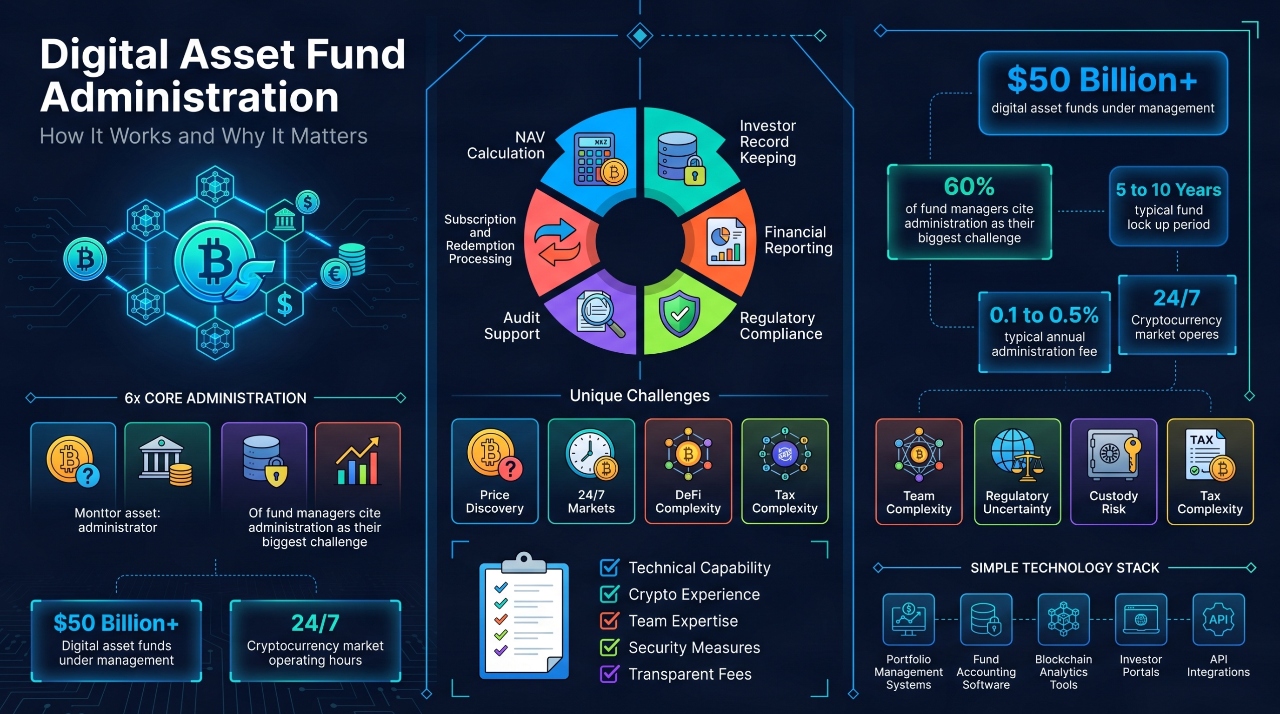
Digital asset funds under management exceeded $50 billion in 2023, yet over 60 percent of crypto fund managers report that administration and compliance are their biggest operational challenges. That gap between money flowing in and operational readiness is exactly where funds fail. Poor administration has caused investor losses, regulatory shutdowns, and legal disasters that proper systems could have prevented.
This article explains digital asset fund administration clearly and honestly. You’ll learn what it is, why it matters, how it works, and how to choose the right administrator for your fund. Whether you’re a fund manager setting up a new crypto fund, an investor evaluating where to put your money, or someone exploring the digital asset industry professionally, this guide gives you the information you need to make smart decisions.
What Is Digital Asset Fund Administration?
Fund administration is the back office work that keeps an investment fund running properly. Think of it like the engine room of a ship. The captain (fund manager) decides where to go, but the engine room keeps everything moving. Without proper administration, even the best investment strategy falls apart.
A fund administrator handles record keeping, tracks investments, calculates fund values, manages investor records, and produces financial reports. These functions happen behind the scenes, but they’re critical to fund operations. Investors rely on this information to know what their investment is worth. Regulators use it to verify compliance. Auditors review it to confirm financial accuracy.
Digital asset fund administration differs from traditional fund administration in important ways. Cryptocurrency and blockchain assets create unique challenges that stocks and bonds never presented. Tracking wallets, tokens, blockchain transactions, and decentralized finance positions requires specialized technical knowledge and purpose built systems. Most traditional fund administrators simply don’t have these capabilities.
The distinction between fund manager and fund administrator matters enormously. Fund managers decide what to invest in and when. Administrators handle everything else: the paperwork, the calculations, the reporting, and the compliance. Separating these roles protects investors because it means someone independent is verifying the numbers the fund manager reports. Many regulators actually require this separation for exactly that reason.
Digital asset fund administration serves many fund types. Cryptocurrency hedge funds, venture capital funds investing in blockchain startups, token funds, DeFi focused funds, and index funds tracking crypto markets all need administration. Each type has slightly different needs, but all require accurate record keeping, proper valuation, and regulatory compliance. The AIMA (Alternative Investment Management Association) publishes detailed guides on fund administration standards that cover both traditional and digital asset funds.
Why Digital Asset Fund Administration Matters
Poor fund administration destroys investor confidence fast. When statements are inaccurate, valuations are inconsistent, or compliance requirements get missed, investors lose trust immediately. Rebuilding that trust is extremely difficult and sometimes impossible. Funds have shut down entirely because of administration failures that had nothing to do with investment performance.
Investor trust depends on independent verification. When an independent administrator calculates fund values and produces investor statements, it removes the possibility that the fund manager is manipulating numbers. This independence is exactly what sophisticated investors and institutional capital require. Without it, raising money from serious investors becomes extremely difficult.
Regulatory requirements make good administration essential, not optional. Regulators like the SEC require accurate record keeping, proper reporting, and documented compliance procedures. Failures result in fines, fund shutdowns, and personal legal liability for fund managers. The consequences are severe enough that no fund can afford to treat administration as an afterthought.
Operational efficiency is another major benefit of proper administration. Fund managers who spend their time on paperwork, reconciliations, and reporting can’t focus on investment decisions. Good administration systems handle routine work automatically, freeing the investment team to do what they’re actually good at. This efficiency also reduces overall fund costs by eliminating manual errors that require expensive correction.
Tax reporting complexity in digital asset funds is substantial. Every transaction, token receipt, staking reward, and DeFi interaction potentially creates a taxable event. Administrators track all of this throughout the year so that accurate tax reporting is possible. Without that tracking, funds face penalties, audits, and massive catch up costs trying to reconstruct transaction histories.
Key Functions of a Digital Asset Fund Administrator
Net asset value calculation is the most fundamental administration function. NAV is simply the total value of everything the fund owns divided by the number of investor shares or units. It sounds simple but becomes extremely complex with digital assets. Cryptocurrency prices change constantly and trade on dozens of exchanges simultaneously. Administrators must have documented methodologies for which prices they use, at what time, and how they handle assets that trade on multiple venues.
Investor record keeping tracks every investor in the fund completely. Administrators maintain records showing who each investor is, how much they invested, when they invested, what fees they paid, and what they’re owed when they withdraw. This information feeds into investor statements, tax documents, and regulatory reports. Accuracy matters because errors in investor records create disputes that are costly and damaging to relationships.
Subscription and redemption processing handles money coming in and going out. When new investors join the fund, administrators verify their identity, process their investment, issue units or shares, and update records. When investors withdraw, administrators calculate what they’re owed, process the payment, and update records accordingly. Crypto funds have unique challenges here because investors may send cryptocurrency directly to fund wallets, requiring blockchain transaction verification.
Financial reporting produces the documents that show fund performance and financial position. Monthly and quarterly reports give investors current information about their investment. Annual audited financial statements provide comprehensive verified financial information. All of these reports must comply with applicable accounting standards and contain accurate, complete information.
Regulatory reporting ensures the fund meets its filing obligations. Depending on the fund’s structure, location, and activities, administrators may prepare SEC filings, CFTC reports, and various other regulatory documents. Missing filing deadlines or submitting inaccurate reports creates regulatory problems. Administrators track these obligations and make sure they’re met on time.
Audit support helps external auditors verify financial statements. Auditors independently verify that what the fund reports is accurate. Administrators provide all the documentation auditors need: transaction records, valuation support, investor records, and bank statements. Clean, organized documentation makes audits faster and cheaper. Poor documentation extends audit timelines and raises questions about fund operations.
The Unique Challenges of Digital Asset Administration
Price discovery creates immediate complexity. Bitcoin trades on Coinbase at one price and Binance at a slightly different price at the exact same moment. Which price should the administrator use for NAV calculation? There’s no single universal answer, but the fund must have a documented, consistent methodology. Inconsistent pricing creates investor disputes and regulatory problems.
Technical infrastructure requirements exceed anything traditional fund administration involves. Administrators need direct connections to blockchain networks, cryptocurrency exchanges, custody providers, and DeFi protocols. Building and maintaining these integrations requires significant technical expertise. A traditional fund administrator who manages stock portfolios has none of this infrastructure and can’t simply add it quickly.
Custody creates challenges unique to digital assets. Cryptocurrency requires private key management. Losing private keys means permanent, irreversible loss of assets. Fund administrators must track assets across multiple custody solutions including cold storage, hot wallets, and institutional custody providers. Each custody solution has different reporting capabilities, making comprehensive tracking difficult.
DeFi positions are among the most complex administration challenges in the industry. When a fund provides liquidity to a DeFi protocol, it receives liquidity pool tokens representing its position. Those positions earn fees continuously and change in value constantly. Tracking yield farming rewards, liquidity positions, staking rewards, and governance tokens requires specialized systems that most traditional administrators simply don’t have.
Regulatory uncertainty adds ongoing complexity. Cryptocurrency regulations differ across countries and change frequently. An administrator serving funds in multiple jurisdictions must track regulatory requirements in each location simultaneously. What satisfies regulators in one country might not satisfy regulators in another. Staying current with regulatory changes across multiple jurisdictions requires dedicated compliance resources.
The 24 hour, 7 day market creates accounting period challenges. Stock markets close at 4pm and everyone agrees on end of day prices. Cryptocurrency markets never close. Administrators must establish specific calculation times for NAV and apply them consistently. A fund that calculates NAV at midnight Eastern time will have different values than one calculating at noon Pacific time, even on the same calendar date.
Key Administration Functions and Their Challenges:
| Function | What It Involves | Main Challenge |
|---|---|---|
| NAV Calculation | Valuing all fund assets | Price varies across exchanges |
| Investor Records | Tracking all investor details | Crypto deposits need blockchain verification |
| Financial Reporting | Producing fund statements | Crypto accounting standards still developing |
| Regulatory Filing | Submitting required reports | Rules differ across jurisdictions |
| Audit Support | Providing auditor documentation | Blockchain records require specialist review |
| Compliance Monitoring | Tracking fund rule adherence | Regulations change frequently |
How Digital Asset Fund Administrators Value Crypto Assets
Valuation is where administration either builds or destroys fund credibility. For major liquid cryptocurrencies like Bitcoin and Ethereum, administrators use market prices from established exchanges. The most common approach uses a volume weighted average price across multiple major exchanges at a specific calculation time. This smooths out temporary price spikes or dips on individual exchanges.
Illiquid assets are far more challenging. Many crypto funds hold tokens that don’t trade on major exchanges or trade in very low volumes. Valuing these assets requires judgment and documented methodology. Administrators may use comparable transaction analysis, looking at similar tokens and their valuations. They may use discounted cash flow models if the project generates revenue. Some funds commission independent valuations from specialist firms.
DeFi positions require continuous monitoring and point in time valuation. A liquidity pool position changes in value every time someone trades through that pool. Staking rewards accrue continuously. Yield farming positions interact with multiple protocols simultaneously. Administrators capture the value of these positions at specific calculation times using blockchain data feeds and specialized DeFi analytics tools.
NFT valuation is genuinely difficult because each NFT is unique. Unlike fungible tokens where one unit equals another, each NFT has individual characteristics that affect its value. When funds hold NFTs, administrators must establish valuation methodologies based on comparable sales, floor prices for that collection, or independent appraisals. Many fund administrators avoid NFTs entirely because the valuation complexity creates too much risk.
Valuation governance protects funds from disputes and regulatory scrutiny. Every fund should have documented valuation policies that specify exactly how each asset type gets valued. An independent valuation committee should oversee pricing decisions. When the regular methodology can’t be applied (maybe because a token suddenly becomes illiquid), the committee decides how to handle it. Documented governance shows regulators and auditors that the fund takes valuation seriously.
Regulatory Compliance in Digital Asset Fund Administration
Anti money laundering requirements apply to all digital asset funds. Funds must verify investor identities through know your customer procedures before accepting investments. Transaction monitoring must identify potentially suspicious activity. Administrators implement these procedures and maintain the records that prove compliance. AML failures carry severe penalties and can result in fund shutdowns.
SEC requirements affect US based digital asset funds significantly. Investment advisers managing above certain thresholds must register with the SEC and comply with extensive rules. Form ADV discloses information about the adviser’s business. Form PF reports information about private fund activities. Administrators help prepare these filings and maintain the records they require throughout the year. Fund managers can review current registration requirements and filing obligations directly through the SEC Investment Adviser resources page to stay current with requirements.
CFTC jurisdiction applies when funds trade crypto derivatives, futures, or certain leveraged products. Crypto futures trading on CME or other regulated exchanges brings CFTC oversight. Administrators must track whether fund activities trigger CFTC registration requirements and help maintain required records if they do.
International regulatory requirements multiply complexity for globally operating funds. European funds and funds accepting European investors must comply with GDPR privacy requirements. FATF recommendations for anti money laundering apply across member countries. MiCA regulations in Europe create new requirements for crypto asset service providers. Administrators managing multi jurisdictional funds must navigate all of these simultaneously.
Record keeping requirements are extensive and non negotiable. Regulators require funds to maintain detailed records for periods ranging from three to seven years depending on the jurisdiction and record type. Transaction records, investor communications, valuation documentation, and compliance records all must be preserved. Administrators build systems to maintain these records in organized, retrievable formats.
How to Choose the Right Digital Asset Fund Administrator
Technical capability is the first and most important evaluation criterion. Ask potential administrators which blockchain networks they support directly. Find out which exchanges they connect to for price data and trade confirmation. Ask about their custody provider integrations. Understand how they handle DeFi positions and NFT valuation. An administrator without genuine technical crypto infrastructure will create problems that cost far more than saving money on cheaper administration.
Experience with digital asset funds matters more than general fund administration experience. Ask how many digital asset funds they currently administer. Request case studies or references from existing crypto fund clients. Find out how long they’ve been administering digital asset funds. Experience prevents costly mistakes that inexperienced administrators make regularly when first encountering crypto’s unique challenges.
Team expertise must combine finance knowledge with crypto technical understanding. Ask about the backgrounds of the people who will actually work on your fund. Do they have traditional fund accounting qualifications? Do they understand blockchain technology? Have they worked specifically with digital assets? You need people who can read both a balance sheet and a blockchain explorer with equal confidence.
Reporting capabilities determine whether investors and regulators will be satisfied. Ask to see sample reports. Evaluate whether they meet your regulatory requirements and investor expectations. Ask how quickly they produce NAV calculations after the calculation date. Find out how they handle reporting for complex positions like DeFi. Ask about investor portal access and real time reporting options.
Security measures protect sensitive financial data that administrators handle daily. Ask about data encryption standards. Find out about access controls and employee security procedures. Ask about disaster recovery and business continuity plans. Request information about their history of security incidents. An administrator security failure exposes your entire fund and investor base to serious risk.
Fee structures vary significantly across administrators. Some charge a percentage of assets under management, typically between 0.1 and 0.5 percent annually. Others charge flat monthly or annual fees. Some charge per transaction or per investor. Get detailed quotes from at least three administrators and compare them carefully. Remember that the cheapest option rarely provides the best value when errors and gaps create expensive downstream problems.
Technology and Software in Digital Asset Fund Administration
Portfolio management systems are the central nervous system of digital asset fund administration. These platforms track all fund investments, current prices, and positions in real time. They connect directly to exchanges and blockchain networks to pull current data. Leading platforms purpose built for digital assets include Lukka, Archax, and Liminal. Generic portfolio systems built for traditional assets usually can’t handle crypto’s technical requirements.
Fund accounting software handles the complex calculations behind NAV, fee calculations, and financial reporting. These systems must accommodate cryptocurrency specific accounting treatments that traditional software doesn’t support. They must handle the high transaction volumes that active crypto funds generate. They must produce financial statements that comply with applicable accounting standards despite those standards still evolving for digital assets.
Blockchain analytics tools give administrators visibility directly into on chain activity. Platforms like Chainalysis and Elliptic connect to blockchain networks and provide transaction tracking, wallet monitoring, and compliance screening. These tools verify that wallet balances match custody records, identify incoming transactions, and screen transactions for connections to sanctioned addresses or illicit activity.
Investor portals provide the interface that investors actually see. Modern fund administration includes secure online portals where investors log in to view account balances, transaction history, and download statements. These portals must be secure, easy to use, and accurate. Poor investor portal experience creates support calls and undermines confidence in the administrator’s overall capabilities.
The Cost of Digital Asset Fund Administration
Administration costs depend heavily on fund size, complexity, and administrator pricing model. Percentage based fees range from 0.1 to 0.5 percent of assets under management annually. A $10 million fund at 0.3 percent pays $30,000 per year in base administration fees. A $100 million fund at the same rate pays $300,000. As fund size grows, percentage fees can become very large relative to the actual work involved.
Flat fee arrangements work differently. An administrator might charge $5,000 to $15,000 per month regardless of fund size. This provides cost certainty for budgeting purposes. Flat fees work well for smaller funds where percentage fees would be insufficient to cover costs, and for larger funds where percentage fees become disproportionately expensive.
Additional costs beyond base fees add up significantly. Technology costs for specialized software may be passed through to the fund. Audit fees for annual audited financial statements often run $25,000 to $75,000 or more depending on fund complexity. Legal fees, regulatory filing fees, and compliance costs add further expenses. Total administration costs frequently run 50 to 100 percent above base administration fees when all costs are included.
The cost versus value calculation matters enormously here. NAV calculation errors create investor disputes that cost far more than any administration fee savings. Regulatory violations from inadequate compliance systems result in fines that dwarf annual administration costs. Investor redemption disputes from poor record keeping destroy fund reputation permanently. Professional administration is genuinely an investment in fund integrity, not merely an expense line.
Common Mistakes in Digital Asset Fund Administration
Choosing an administrator without genuine crypto experience is the most costly mistake fund managers make. Traditional administrators who claim they can handle digital assets without purpose built systems and experienced staff consistently create problems. They miss DeFi positions, misvalue illiquid tokens, and produce reports that don’t satisfy crypto fund auditors. The cost of fixing these problems always exceeds the cost of choosing a qualified administrator from the start.
Starting to invest before administration is properly set up creates record keeping nightmares. Some fund managers begin trading before signing with an administrator, intending to sort it out later. Reconstructing transaction histories retroactively is extremely expensive and often incomplete. Auditors question gaps in records. Regulators raise concerns about the period before proper administration began.
Inadequate NAV calculation policies create disputes that damage investor relationships. Funds without documented valuation methodologies make inconsistent decisions that produce inconsistent results. When one month’s NAV uses one pricing methodology and the next month’s uses a different one, investors and auditors ask uncomfortable questions. Valuation governance must be established before the first NAV calculation.
Underestimating compliance requirements is dangerously common. Many first time fund managers don’t realize how extensive digital asset compliance obligations are. AML programs, KYC procedures, regulatory filings, and record keeping requirements all need proper infrastructure. Adding compliance systems after regulatory scrutiny begins is vastly more expensive than building them correctly from day one.
Conclusion
Digital asset fund administration is not optional, not a formality, and not something to figure out later. It’s the foundation that determines whether your fund operates legally, earns investor trust, and survives regulatory scrutiny. The $50 billion flowing into digital asset funds makes proper administration more important than ever because more money means more regulatory attention.
The right fund administrator brings technical capability, crypto specific experience, regulatory expertise, and the reporting infrastructure that sophisticated investors require. Choosing wrong creates problems that no amount of good investment performance can overcome. Investor disputes, regulatory violations, and audit failures destroy funds that might have had excellent investment results.
The best time to set up proper fund administration is before you accept your first investor dollar. Retroactive fixes are expensive, incomplete, and raise red flags with auditors and regulators. Starting with professional administration from day one signals to investors and regulators that you take fund governance seriously. That signal matters more than most fund managers realize.
Evaluate multiple administrators thoroughly. Check technical capabilities. Verify experience with digital asset funds specifically. Talk to their existing clients. Understand every fee and cost. The right administrator becomes a long term partner in fund success, not just a service provider.
Research digital asset fund administrators and consult with legal and compliance professionals before launching your fund. Share questions in the comments below. Explore our other articles about crypto fund management, regulatory compliance, and digital asset investing to build a complete picture of what running a successful digital asset fund requires.