
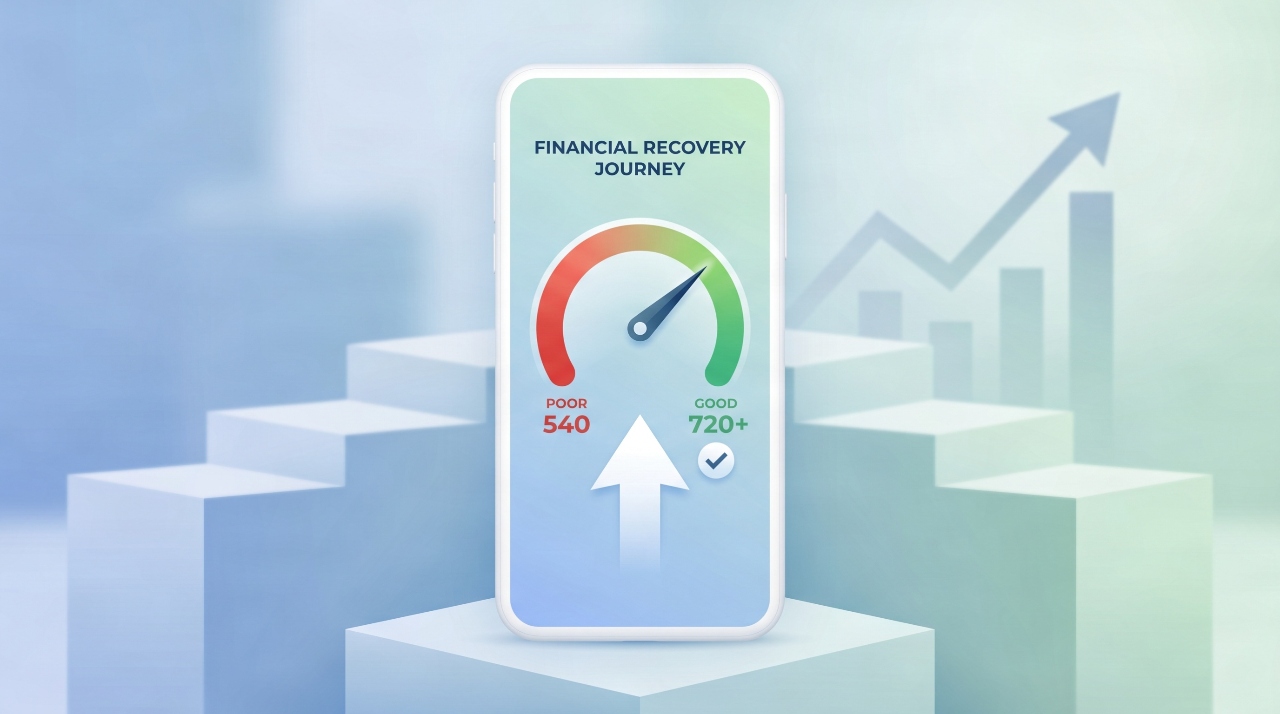
Over 400,000 Americans file for bankruptcy each year, and most see their credit scores drop between 130 to 200 points immediately after filing. If you are reading this, you probably know that sinking feeling when you checked your credit score after bankruptcy. The number looked terrible. You might have wondered if your financial life was over. Here is the truth: bankruptcy is not a permanent financial death sentence. Rebuilding credit is absolutely possible with the right approach. Most people see real improvements within 12 to 24 months. This article will show you exactly what steps to take, in what order, to rebuild your credit faster than you thought possible. You can recover from this.
What Happens to Your Credit Score During Bankruptcy
Bankruptcy affects credit scores differently based on your starting point. Someone with a 780 score might drop to 540, while someone at 680 might fall to 530. The higher your score before bankruptcy, the harder you fall. This seems unfair, but credit scoring models see it as a bigger risk when someone with excellent credit management suddenly cannot pay their debts.
Chapter 7 and Chapter 13 bankruptcies impact your credit differently. Chapter 7 stays on your credit report for 10 years but discharges debts completely. You start fresh but carry that notation for a decade. Chapter 13 remains for 7 years because you repay some debts through a payment plan. Either way, the bankruptcy notation itself causes the biggest score drop, not the individual debts being discharged.
The negative impact decreases over time. Credit scoring models weigh recent activity more heavily than old information. The most severe effects happen in the first two years. After that, each month of positive credit behavior gradually rebuilds your score.
How Long Does Bankruptcy Affect Your Credit Score
Bankruptcy remains on your report for 7 to 10 years depending on type, but its impact lessens significantly after 2 years. Many people can achieve fair credit scores between 580 to 669 within 12 to 18 months after discharge. Good credit scores from 670 to 739 are possible within 2 to 3 years with consistent effort.
The key is what you do after bankruptcy, not how long it stays on your report. Lenders look at your entire credit profile. A bankruptcy from three years ago with perfect payment history since looks much better than a bankruptcy from six months ago with new late payments. You are proving through actions that you have changed your financial habits.
Many people believe they must wait until bankruptcy falls off their report to get decent credit again. This is completely wrong. Thousands of people with bankruptcy notations still on their reports have credit scores above 700. Fresh positive information matters more than old negative information as time passes.
Check Your Credit Reports for Errors
This is your critical first step. Get free copies from all three bureaus through AnnualCreditReport.com. This is the only authorized website for free credit reports. Ignore other sites that claim to offer free reports but actually want to sell you monitoring services.
Look for debts that should show zero balance after discharge but still show amounts owed. This happens more often than you would think. Also verify that all included debts are marked as “discharged in bankruptcy” or “included in bankruptcy.” Check for duplicate entries where the same debt appears multiple times under different account numbers.
Look for accounts that were never yours or incorrect late payment marks after your filing date. Some creditors continue reporting late payments even after your bankruptcy filing, which is illegal. Write down every error you find with the account name, number, and what is wrong.
Dispute errors with each bureau in writing. State the facts clearly without emotional language. Include copies of your bankruptcy discharge papers showing which debts were included. Keep records of all disputes and responses in a folder. The bureaus have 30 to 45 days to investigate and respond.
Some people find 5 to 10 errors on their reports after bankruptcy. Fixing these can boost scores by 20 to 50 points immediately. This quick win motivates you to continue the longer rebuilding process.
Create a Realistic Budget and Stick to It
All credit rebuilding depends on making future payments on time. You cannot rebuild credit if you overspend and miss payments. Start by tracking every dollar you spend for one month. Write it down or use a phone app. This shows where your money actually goes, not where you think it goes.
Calculate your total income after taxes. List all necessary expenses like housing, utilities, food, and transportation. Find the difference between income and expenses. This number shows how much breathing room you have each month.
Use the 50/30/20 rule as a guide. Put 50% of income toward needs like rent and groceries. Use 30% for wants like entertainment and eating out. Direct 20% toward savings and any debt payments. These percentages are guidelines, not rigid rules. Adjust based on your situation.
Build an emergency fund of at least $500 to $1000 as quickly as possible. This prevents using credit cards for unexpected car repairs or medical bills. Even saving $25 per week gets you to $1000 in less than a year. A small emergency fund protects all your credit rebuilding progress.
Open a Secured Credit Card
A secured credit card requires you to deposit money, usually $200 to $500, that becomes your credit limit. This deposit protects the card issuer, making them willing to approve you despite bankruptcy. Secured cards function exactly like regular credit cards and report to credit bureaus monthly.
Research cards that report to all three bureaus, not just one or two. Look for cards with low or no annual fees. The Discover it Secured Card, Capital One Platinum Secured, and OpenSky Secured Visa are solid options. Avoid cards with application fees, processing fees, or monthly maintenance fees that eat into your deposit.
Use the card for small, regular purchases like gas or groceries. Pay the full balance every month before the due date. Never carry a balance or pay interest. The goal is building payment history, not borrowing money. Set up automatic payments from your checking account so you never miss a due date.
Keep your utilization below 30% of your limit, but ideally under 10%. If your limit is $300, charge no more than $30 per month. This shows credit bureaus you can use credit responsibly without maxing out cards. High utilization hurts your score even if you pay in full each month.
After 12 to 18 months of perfect payment history, many issuers will graduate you to an unsecured card and return your deposit. Your credit limit often increases too. Some people open 2 secured cards to build credit faster, but only if you can manage both responsibly. More cards means more chances to make mistakes.
Become an Authorized User on Someone Else’s Account
This strategy works when someone with good credit adds you to their credit card account. You get a card with your name, but the primary holder is responsible for payments. Their positive payment history can appear on your credit report immediately.
Choose someone who has had their card for several years, always pays on time, and keeps utilization low. Parents, siblings, or trusted friends are common choices. Have an honest conversation about expectations. Make sure they understand you are trying to rebuild credit.
Verify that the card issuer reports authorized users to credit bureaus, as not all do. Capital One, Bank of America, and Chase typically report authorized user status. Call the issuer and ask directly before going through the process.
This can add years of positive credit history to your report instantly. Some people see score increases of 20 to 60 points within 30 to 60 days. You do not even need to use the card yourself. The benefit comes purely from the account appearing on your report.
Be aware that if the primary holder misses payments or maxes out the card, it hurts your score too. Only do this with someone financially responsible who you trust completely. You can be removed as an authorized user anytime if the relationship changes or their financial situation deteriorates.
Consider a Credit Builder Loan
Credit builder loans work differently than regular loans. You borrow a small amount, typically $300 to $1000, but the lender holds the money in a savings account. You make monthly payments for 6 to 24 months. After you complete all payments, you get the money back plus any interest earned.
The lender reports your payments to credit bureaus, building positive payment history. Banks, credit unions, and online lenders offer these loans. Credit unions often have the best terms with lower fees and interest rates around 6% to 12%. Self Financial and Credit Strong are popular online options.
The interest you pay is essentially the fee for building credit. Look for loans with annual percentage rates below 16% if possible. Make sure the lender reports to all three credit bureaus, not just one. Monthly payments typically range from $25 to $100 depending on the loan amount and term.
Set up automatic payments to ensure you never miss one. Missing even one payment defeats the entire purpose and damages your score. This strategy works well combined with a secured credit card because it adds installment loan history to your report. Credit scores benefit from having both revolving credit and installment credit.
After 6 to 12 months of on time payments, you will see score improvements of 15 to 35 points. Plus you end up with savings you did not have before. This creates a small emergency fund that protects your financial progress.
The Consumer Financial Protection Bureau provides guidance on choosing credit builder loans that report to all three credit bureaus.
Pay All Bills on Time, Every Time
Payment history is the single biggest factor in credit scores, making up 35% of your FICO score. One late payment can drop your score by 60 to 110 points. After bankruptcy, you cannot afford any mistakes. Set up automatic payments for everything possible including utilities, phone, internet, and rent or mortgage.
Most companies allow automatic bank withdrawals or credit card charges. For bills that vary each month, set up calendar reminders 5 days before due dates. Use your phone calendar with alerts so you never forget.
Payments are considered on time if received by the due date, not 5 or 10 days later. Some creditors report late payments to credit bureaus after 30 days past due, while others report sooner. Even if a creditor does not report to bureaus, late fees add up and waste money.
If you anticipate trouble making a payment, contact the creditor immediately. Many will work out payment plans or temporary hardship arrangements. They would rather receive partial payment than send your account to collections. Collections accounts severely damage credit scores and restart the clock on credit recovery.
Keep Credit Utilization Low
Credit utilization is the ratio of your credit card balances to your credit limits. It accounts for 30% of your credit score. Keep total utilization below 30% across all cards, but under 10% is ideal for maximum score benefit. If you have a $500 limit, keep your balance below $50.
Calculate utilization by dividing your balance by your limit and multiplying by 100. A $150 balance on a $500 limit is 30% utilization. Credit card companies typically report your balance to bureaus once per month, usually on your statement closing date. This reported balance determines your utilization, not what you owe on the due date.
You can charge more during the month as long as you pay it down before the statement closes. Some people pay their balance twice per month to keep the reported amount low. As your credit improves and you get higher limits, utilization becomes easier to manage.
Request credit limit increases after 6 to 12 months of perfect payments. Higher limits automatically lower your utilization percentage if you keep spending the same. A $200 balance is 40% of a $500 limit but only 10% of a $2000 limit. Never close old credit cards even if you do not use them. Closing cards reduces your total available credit and increases utilization.
What Not to Do While Rebuilding Credit
Avoid applying for multiple credit cards or loans at once. Each application triggers a hard inquiry that can lower your score by 5 to 10 points. Multiple inquiries in a short time look desperate and risky to lenders. Space out applications by at least 6 months.
Never co-sign loans for anyone, even family members. You become legally responsible if they do not pay, and late payments appear on your credit report. After bankruptcy, you cannot risk someone else’s financial problems affecting your recovery.
Ignore companies that promise to remove bankruptcy from your credit report for a fee. This is impossible and usually a scam. Bankruptcy can only be removed if it was filed in error or you can prove identity theft. These companies charge hundreds of dollars to do nothing you cannot do yourself for free.
Do not use payday loans or title loans. These predatory products charge interest rates of 300% to 400% annually and trap you in debt cycles. They rarely report to credit bureaus anyway, so they do not help build credit. They only drain your bank account and create new financial problems.
Do not max out credit cards to earn rewards or cash back. The high utilization damages your score more than any rewards are worth. Do not make only minimum payments on credit cards if you can afford more. While minimums keep you current, carrying balances month to month costs money in interest and provides no extra credit score benefit.
Monitor Your Progress Regularly
Track your credit score monthly to stay motivated. Many credit card issuers now provide free FICO scores to cardholders. Check your card statements or online account for this feature. Apps like Credit Karma and Credit Sesame offer free VantageScore credit scores. While these differ slightly from FICO scores that most lenders use, they show trends and progress accurately.
Watch for your score to climb steadily each month, typically by 5 to 15 points if you follow all the steps correctly. Some months show no change or small drops. This is normal. Focus on the overall trend over 6 to 12 months, not month to month fluctuations.
Check your full credit reports every 4 months, rotating through the three bureaus. Pull Experian in January, TransUnion in May, and Equifax in September. This gives you year round monitoring without paying for services. Look for changes in account status, new inquiries you did not authorize, or errors that need disputing.
Celebrate milestones like crossing 600, then 650, then 700. These thresholds open up better credit card offers, lower insurance rates, and eventually mortgage and auto loan approval. Seeing measurable progress keeps you motivated during the rebuilding process.
When Can You Apply for Major Credit Again
Set realistic expectations for different types of credit. Secured credit cards are available immediately after bankruptcy discharge. Store credit cards become possible after 12 to 18 months of rebuilding, though interest rates will be high. Unsecured credit cards from major issuers typically require 18 to 24 months post bankruptcy plus scores above 600.
Auto loans are possible 1 to 2 years after bankruptcy, but expect higher interest rates and larger down payment requirements of 10% to 20%. Shop around because some lenders specialize in post bankruptcy auto loans with reasonable terms.
FHA mortgages allow applications 2 years after Chapter 7 bankruptcy discharge or 1 year into a Chapter 13 repayment plan, assuming you have reestablished good credit. Conventional mortgages typically require waiting 4 years after Chapter 7 or 2 years after Chapter 13 discharge.
These timelines assume you have rebuilt credit responsibly with no new late payments or collections. Each lender has different policies, so some may approve you sooner while others make you wait longer. Focus on rebuilding first rather than rushing to apply for credit you might not get. Getting denied for credit triggers hard inquiries that lower your score without any benefit.
Additional Strategies for Faster Credit Recovery
Rent reporting services like Rental Kharma or RentTrack report your monthly rent payments to credit bureaus. Since rent is typically your largest monthly expense, getting credit for on time payments helps significantly. Some services charge $50 to $100 annually, while others take a percentage of each payment. Verify they report to all three bureaus before signing up.
Experian Boost allows you to add utility and phone payment history to your Experian credit report. This free service connects to your bank account and identifies eligible payments. It only affects your Experian score, not TransUnion or Equifax, but some lenders only check Experian. People typically see score increases of 10 to 20 points immediately after adding 3 to 6 months of payment history.
Join a credit union and build a relationship. Credit unions are often more willing to work with members who have bankruptcy history. They offer second chance checking accounts, credit builder loans with favorable terms, and secured cards with lower fees than big banks.
Take a financial education course through nonprofit credit counseling agencies. The National Foundation for Credit Counseling connects you with certified counselors who provide free or low cost advice. Some offer classes on budgeting, credit rebuilding, and money management. Completing these courses shows future lenders you are serious about financial responsibility.
Real Timeline: What to Expect Month by Month
Month 1 to 3 after bankruptcy discharge: Receive discharge papers, check credit reports for accuracy, dispute any errors, create a budget, open a secured credit card or credit builder loan. Your score remains low but you are building the foundation. Expect your score to stay between 500 to 550 during this period.
Months 4 to 6: Make perfect on time payments on all accounts, keep utilization below 10%, consider becoming an authorized user. Start seeing small score increases of 10 to 30 points total. Your score might reach 560 to 580 by the end of this period.
Months 7 to 12: Continue perfect payment history, request credit limit increase on secured card, add a second secured card if managing the first one easily. Scores typically reach 580 to 620 range. You cross into fair credit territory and start receiving credit card offers in the mail.
Months 13 to 18: May qualify for unsecured credit cards with decent terms, consider auto loans if needed. Scores often reach 620 to 660 range. You notice real differences in what financial products become available to you.
Months 19 to 24: Solid fair to good credit established, qualify for better credit cards with rewards, lower interest rates on loans. Scores typically reach 650 to 700 range. Some people hit 700 or above at this point with aggressive rebuilding.
Years 3 to 4: Qualify for conventional mortgages, prime credit cards, competitive loan rates. Scores often reach 700 plus range. The bankruptcy notation still appears on your report but matters less because of strong recent payment history.
Everyone’s timeline varies based on starting point, number of accounts, and consistency of good behavior. Some people rebuild faster while others take longer. The key is steady progress, not perfection.
Common Questions About Credit After Bankruptcy
Many people ask if they should pay off old debts that were discharged in bankruptcy. The answer is no from a credit perspective. Discharged debts are legally eliminated and paying them provides no credit score benefit. The accounts should show zero balance owed. However, some people choose to repay debts for moral or relationship reasons, which is a personal decision unrelated to credit scores.
Another common question is whether married couples both take the credit hit if only one spouse files bankruptcy. Bankruptcy only affects the person who files. If your spouse has separate credit accounts you are not on, those accounts remain unaffected. However, any joint accounts will show the bankruptcy on both credit reports.
People often ask if they need to hire a credit repair company. The answer is almost always no. Everything a credit repair company can legally do, you can do yourself for free. These companies charge $50 to $150 monthly but usually just dispute items on your credit report, which you can do at no cost.
Many wonder if bankruptcy prevents them from renting an apartment. Most landlords check credit, and bankruptcy makes approval harder but not impossible. Offer to pay a larger security deposit, provide references from previous landlords, or show proof of income and current budget management. Some landlords care more about recent payment history than old bankruptcy, especially if you can explain the circumstances honestly.
Your Credit Recovery Starts Today
Bankruptcy damages credit significantly but not permanently. Recovery requires patience, discipline, and consistent effort over 18 to 36 months. The seven core steps work together to rebuild credit systematically. Check your reports for errors and dispute them immediately. Create a budget that prevents overspending. Open a secured credit card and use it responsibly. Become an authorized user on someone else’s account if possible. Get a credit builder loan to add installment payment history. Pay everything on time without exception. Keep credit utilization below 10% at all times.
Your credit score will improve faster than you expect if you follow this plan. Many people achieve fair credit within one year and good credit within two years. The bankruptcy notation matters less over time as positive payment history accumulates. Lenders eventually care more about what you have done recently than what happened years ago during a difficult financial period.
Get your free credit reports today at AnnualCreditReport.com and start your credit rebuilding plan this week. Pick one action from this guide, complete it within the next 7 days, then move to the next step. Your financial future is in your hands, and it starts right now.